In last week’s post, we explored why enterprises can no longer afford to rely on legacy commerce platforms like SAP Hybris. This week, we move to the next step: comparing Adobe Commerce, SAP Hybris, and SAP Commerce Cloud. Let us see which option best positions a business for 2025 and beyond.
The platform you choose in 2025 will shape your digital maturity, customer experience, and ability to scale. SAP Hybris is coming to its end, and Adobe Commerce is growing fast. SAP Commerce Cloud is focusing on compliance, so the choice is urgent and important.

Major risks enterprises incur by delaying Hybris migration and updates.
By 2025, enterprise commerce has reached an inflection point. Legacy platforms such as Hybris are winding down. At the same time, cloud-native and marketing-focused solutions are becoming mainstream. Analysts say Adobe Commerce is gaining strength. It often ranks higher than SAP Commerce Cloud in catalog management and flexibility.
- SAP Commerce (on-premise, version 2205, formerly “Hybris”) will end mainstream maintenance on July 31, 2026.
- According to SelectHub’s comparison (September 2025), Adobe Commerce holds an analyst rating of 96. SAP Commerce Cloud is rated at 87.
- Global eCommerce sales are expected to hit US$8.09 trillion by 2028, up from about US$6.9 trillion in 2025.
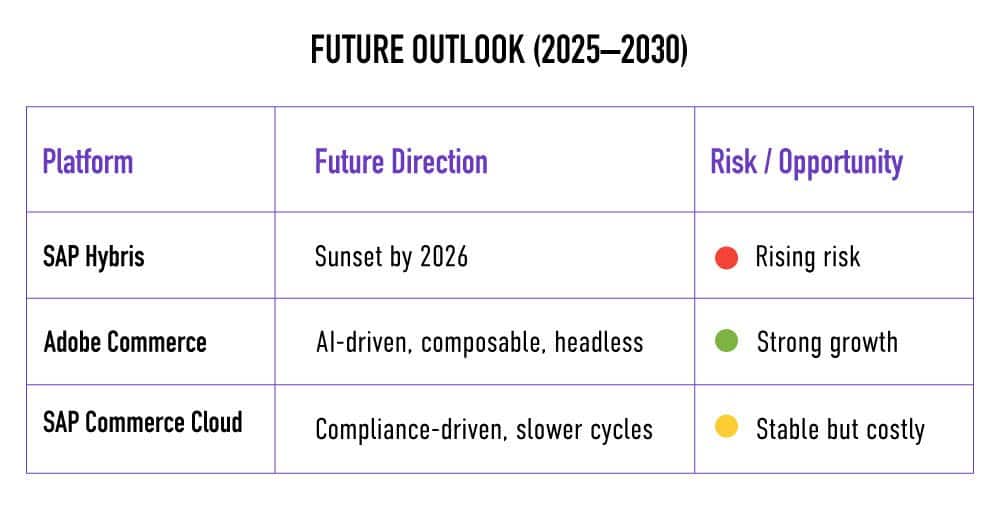
Outlines long-term direction, growth potential, and associated risks.
What is the key decision for enterprises?
- Stay on SAP Hybris: offers short-term stability but creates long-term risk.
- Move to Adobe Commerce: gives agility, extensibility, and stronger marketing alignment.
- Shift to SAP Commerce Cloud: ties into the SAP ecosystem with strong compliance, but comes with higher cost and less flexibility.
Platform Foundations: What Are Enterprises Choosing Between?
SAP Hybris: why is it still in play?
SAP Hybris is the on-premise platform that once set the pace for enterprise B2B and B2C. It brings stability and close SAP integration, but its relevance is fading fast. Mainstream maintenance ends in July 2026, leaving businesses with limited time to plan a move.
Key points:
- Designed for complex B2B commerce
- Strong catalog and role-based buying tools
- Heavy IT support needed for upgrades and compliance
- End of life makes migration unavoidable
Adobe Commerce: why does it stand out in 2025?
Adobe Commerce, built from Magento, has grown into a top choice. It blends flexibility with enterprise-grade features and links content with commerce. Analysts now score it ahead of SAP Commerce Cloud in catalog, marketing, and order management.
Advantages:
- Highly customizable with a large extension marketplace
- Direct tie-in with Adobe Experience Cloud for marketing and personalization
- Supports headless and composable setups
- Strong analyst ratings in core commerce features
Why leaders choose it:
- Faster time to market
- Lower upfront costs than SAP Commerce Cloud
- More flexibility for customer-focused and marketing-driven businesses
SAP Commerce Cloud: how does it position itself?
SAP Commerce Cloud is the successor to Hybris, rebuilt for the cloud. It delivers scale and compliance features global companies require. Its tight link with SAP’s Business Technology Platform makes it best for firms already invested in SAP.
Strengths:
- Strong compliance and audit support
- Global scalability with managed infrastructure
- Seamless integration with SAP ERP and CX
- Backed by SAP’s enterprise support
Limitations
- Higher overall cost of ownership
- Slower pace of innovation than Adobe Commerce
- Limited flexibility for non-SAP integrations
Key Comparison Areas
What role does architecture play in platform choice?
The design of a platform decides how easily a business can change and grow. Rigid systems slow progress, while flexible ones help companies respond faster to customer needs.
SAP Hybris uses a single, heavy model that needs more upkeep. Adobe Commerce is modular and API-first, so updates are quicker and easier. SAP Commerce Cloud supports global work but slows decisions with extra rules.
The comparison:
- Hybris: Reliable but not flexible.
- Adobe Commerce: Modular, adaptable, API-first.
- SAP Commerce Cloud: Structured and best for enterprises with governance needs.
How do scalability and performance compare?
Scalability is more than handling traffic spikes. It means growing globally, keeping performance steady, and giving customers a smooth experience.
Hybris still works well. But in 2025, it needs heavy spending on servers. It also requires skilled staff. Adobe Commerce grows faster. This is because of its strong developer community. It also has a wide range of extensions. SAP Commerce Cloud supports global scale. But it needs bigger budgets. It also requires specialized teams to maintain.
Key insights for enterprises:
- Hybris: Solid performance but costly to scale.
- Adobe Commerce: Quick performance gains through community-driven innovation.
- SAP Commerce Cloud: Built for global scale but resource-intensive
How flexible is customization and ecosystem support?
Customization decides how well a platform aligns with unique business models. Ecosystem strength ensures that innovation does not always depend on in-house development.
Hybris has strong basic features, but customizing it is often slow and costly. Adobe Commerce does better, with thousands of extensions, a large developer community, and strong Adobe support giving it more flexibility. SAP Commerce Cloud fits smoothly into the SAP ecosystem but can feel limiting if a business needs solutions outside SAP’s set framework.
Comparison at a glance:
- Hybris: Customization possible but costly.
- Adobe Commerce: Large ecosystem, fast innovation, easy to build tailored experiences.
- SAP Commerce Cloud: Best for SAP-first integrations, less flexible outside that ecosystem.
How do integration and compliance shape platform value?
Integration shows how easily a platform links to ERP, CRM and outside systems. Compliance is about meeting rules in different markets.
Hybris depends on older integration models. With support ending, those create risk. Adobe Commerce delivers frequent updates, security fixes and strong links to third-party tools. That makes it a fit for companies in fast-moving markets. SAP Commerce Cloud stands out on compliance. It matches global rules and works best for regulated industries and large enterprises.
Key takeaways:
- Hybris: Old integrations and higher compliance risk.
- Adobe Commerce: Frequent updates, strong integrations and marketing stack fit.
- SAP Commerce Cloud: Compliance leader suited for global operations.
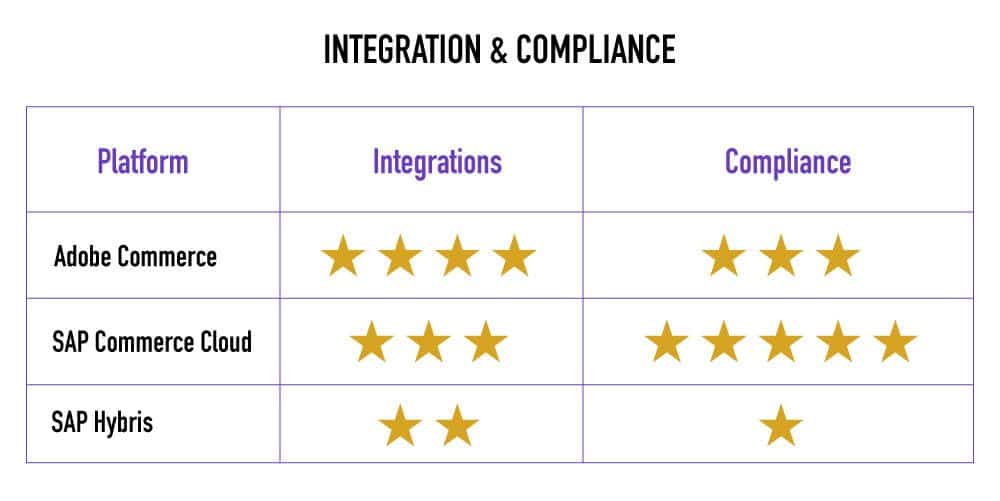
Evaluates readiness for enterprise systems, regulations, and global standards.
Which platform delivers the strongest B2B and omnichannel features?
In 2025 B2B features and omnichannel support are essential as businesses need to manage buyer roles and complex contracts across channels.
Hybris is reliable for B2B and handles contracts effectively. Adobe Commerce supports both B2B and B2C with strong personalization. SAP Commerce Cloud is best for enterprises with complex B2B needs when their back-end already runs on SAP. Enterprise-ready strengths:.
- Hybris: Well established for complex B2B.
- Adobe Commerce: Balanced for hybrid B2B and B2C, strong personalization.
- SAP Commerce Cloud: Best for high complexity B2B in SAP-centric organizations.

Compares capabilities for personalization, contracts, and hybrid commerce.
How should businesses compare cost and total cost of ownership (TCO)?
Total cost of ownership covers more than license fees. It includes infrastructure, maintenance, and day-to-day operations. For decision-makers, this is one of the most critical comparisons.
Hybris may look affordable with lower licensing. But hidden costs from security patches, ongoing maintenance, and limited vendor support add up quickly. Adobe Commerce often delivers better value for companies that need agility and speed. Its open-source base and large community lower cost and improve flexibility. SAP Commerce Cloud sits at the top end of the cost curve. Its higher licensing and governance costs make sense for enterprises that need compliance and global scale. Smaller firms may find it hard to justify.
Cost lens summary:
- Hybris: Legacy maintenance drives hidden costs higher.
- Adobe Commerce: Lower entry cost, strong agility, efficient at scale.
- SAP Commerce Cloud: Expensive but suited to global compliance needs.
What Businesses Need in 2025 and Beyond
Why is an omnichannel experience essential?
By 2025, omnichannel is no longer a differentiator. Customers expect consistent experiences across web, mobile, and physical channels. Platforms must synchronize inventory, promotions, and personalization across every touchpoint to stay competitive.
How central is personalization?
Personalization is now key to keeping customers engaged. Adobe Commerce leads with Adobe Experience Cloud. SAP Commerce Cloud uses SAP data for personalization. Hybris is falling behind on this front.
Why does innovation speed matter?
Faster updates help businesses launch quickly. Adobe Commerce benefits from its large extension ecosystem. SAP Commerce Cloud is stable but slower. Hybris relies more on costly custom work.
This shows the differences in speed, flexibility and adoption.

Illustrates differences in evolution speed, flexibility, and market adoption.
What role does headless architecture play?
Headless setups let enterprises adapt faster and launch new experiences without changing the back end. Adobe Commerce is strong in this area. SAP Commerce Cloud supports it with governance. Hybris continues to lag.
How important is risk minimization?
Security and compliance are critical today. Adobe Commerce provides frequent patches. SAP Commerce Cloud is strong in compliance. Hybris faces higher risks as support winds down.
Which Platform Suits What Kind of Business
When does SAP Hybris still make sense?
Hybris remains relevant for enterprises heavily tied to SAP with on-premise workflows that can’t shift overnight. But with end-of-support on the horizon, it’s best seen as a short-term solution while laying out a migration plan.
Who benefits most from Adobe Commerce?
Adobe Commerce is a strong fit for businesses that value agility, faster time to market, and content-driven commerce. It comes with lower upfront costs, strong community backing, and the flexibility to scale. Companies with marketing-driven goals and teams equipped to handle development get the most value here.
Where does SAP Commerce Cloud deliver the most value?
SAP Commerce Cloud serves large enterprises already committed to the SAP ecosystem. It stands out in compliance, governance, and global scalability. For businesses in regulated industries or managing complex multinational operations, its structure justifies the higher cost.
Future Proofing Beyond 2025
What is the outlook for SAP Hybris?
Hybris is approaching end-of-life, with mainstream maintenance ending in 2026. Beyond that, enterprises face mounting risks in security and support. Migration to cloud-based or modern platforms is no longer optional; it’s a necessity.
How is Adobe Commerce evolving?
Adobe Commerce is shifting to modular, composable commerce with closer links to Adobe Experience Cloud. Its AI-driven personalization and headless setup make it a future-ready choice for companies that want agility.
What is SAP Commerce Cloud focusing on?
SAP Commerce Cloud is expanding its cloud-native capabilities. It supports headless front-ends and global scale, though legacy complexity still shapes its path. The trade-off remains clear: stronger governance versus slower innovation.
Business Outcomes to Expect
What should businesses expect from SAP Hybris?
Hybris delivers stability and reliable B2B functionality. But as support winds down, costs and risks will climb. In the short term, it’s dependable; in the long term, it’s unsustainable.
What outcomes come with Adobe Commerce?
Adobe Commerce drives agility, faster launches, and closer alignment with marketing. Companies benefit from strong SEO, personalization features, and lower total cost of ownership compared to heavy enterprise systems. For many, it offers the best balance of cost and capability.
How does SAP Commerce Cloud perform in practice?
SAP Commerce Cloud provides compliance, governance, and scale for global players. But innovation is slower, and costs run higher. It remains the most secure choice for SAP-centric, regulated enterprises willing to trade speed for assurance.
Key Considerations Before Deciding
How urgent is the need to move away from Hybris?
Support ends in 2026. Staying on Hybris will mean higher costs and growing security risks. Migration is not a long-term choice. It is now a priority.
What skills and resources are needed for Adobe Commerce
Adobe Commerce is flexible, but it is not plug-and-play. Success depends on skilled developers or strong implementation partners. Without that investment, most businesses will not unlock its full value.
When does SAP Commerce Cloud justify its higher cost?
SAP Commerce Cloud makes sense for enterprises already invested in the SAP ecosystem. Its compliance and governance strengths outweigh cost for regulated industries and global operations where risk tolerance is low.
What is the best path forward for enterprises in 2025?
The best platform depends on how well it matches business priorities.
For enterprises that need agility and faster launches, Adobe Commerce is the strongest choice.SAP Commerce Cloud is better suited for compliance-driven global businesses.SAP Hybris is now only a short-term bridge with rising risks.
The smart approach is to evaluate your commerce stack against goals for the next three to five years. Acting early helps avoid higher costs, compliance issues, and lost revenue from legacy systems. Ziffity can help compare Adobe Commerce and SAP Commerce Cloud to your priorities and create a migration roadmap for growth. Book a strategy consultation today.