A countdown has begun for thousands of enterprises still running SAP Commerce (SAP Hybris) on-premise—and the clock hits zero on July 31, 2026!
That reality is about to change. SAP has confirmed that mainstream maintenance for SAP Commerce (formerly Hybris on-premise) will officially end on July 31, 2026, leaving only customer-specific support with no new upgrades or regular fixes. Beyond this deadline, security risks and operational costs will rise, making migration a necessity rather than a choice.
This is not just a technical detail. In eCommerce, customer expectations, security requirements, and compliance demands are evolving rapidly. Running on a system that is no longer supported means you will fall behind competitors who are already planning their next move.
Why is SAP Hybris On-Premise Support Ending?
IThe decision is part of SAP’s broader strategy. The company is shifting from traditional software to a cloud-first model. Instead of investing in on-premise versions of Hybris, SAP wants businesses to adopt SAP Commerce Cloud, which offers scalability, faster updates, and integration with the rest of its cloud ecosystem.
When SAP says “end of support,” it means:
- No major upgrades or new features will be released.
- Minimal security patches
- Reduced technical help, leaving businesses reliant on in-house expertise
This creates a widening gap between on-premise Hybris and modern platforms. The longer businesses wait, the harder and more expensive migration becomes.
What Risks Do eCommerce Businesses Face Without SAP Hybris Support?
When vendor support ends, the problems don’t show up all at once. They creep in. For eCommerce businesses, that slow build-up can be even more damaging than a sudden system failure. The main risks are clear.
- Security gaps: New vulnerabilities appear every month. Without updates, those gaps stay open. It only takes one incident to damage both customer trust and brand reputation.
- Compliance pressure: Rules around data privacy and online payments keep evolving. Running an unsupported system makes audits harder and fines more likely.
- Maintenance costs: Keeping old infrastructure alive is expensive. You end up paying specialists to patch issues that should have been solved with regular updates. Over time, the cost of maintaining Hybris on-premise is often higher than moving to a modern platform.
- Falling behind on innovation: Competitors are adopting cloud platforms with built-in AI, faster deployment cycles, and better customer personalization. Hybris on-premise cannot keep up, which means your teams spend more time fixing problems and less time building new experiences.
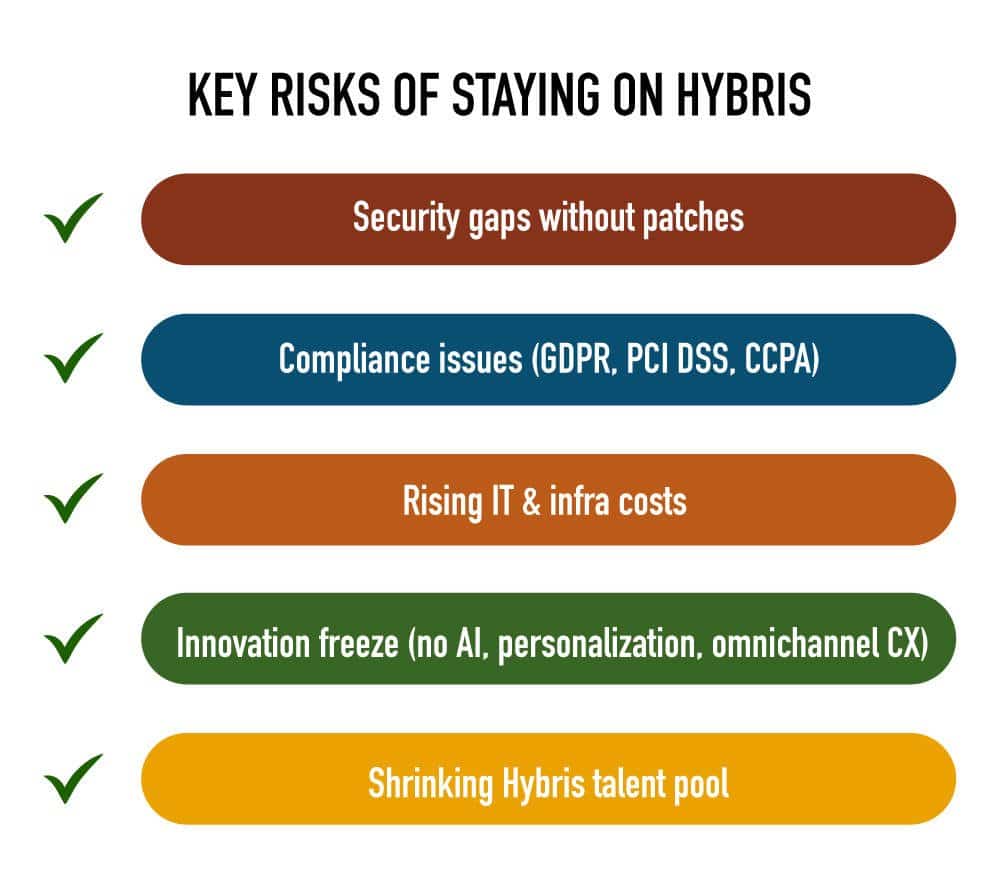
Major risks enterprises incur by delaying Hybris migration and updates.
If leadership views staying on Hybris as a “safe” option, reframe it. The real risk lies in doing nothing while competitors move forward.
How Does the End of Hybris On-Premise Support Affect Different eCommerce Segments?
The end of Hybris on-premise support will not land the same way for every business. Retailers, manufacturers, and distributors each face different challenges, and the risks show up in different parts of the operation.
- Retail: For retailers, everything comes back to the customer experience. Shoppers want speed, personalization, and consistency, whether they are online, on mobile, or standing in a store. Without ongoing updates, Hybris struggles to keep up with omnichannel demands. That gap is visible and customers notice.
- Manufacturing: Manufacturers rely on B2B features like tiered pricing, partner portals, and ERP integration. If the platform is unsupported, those integrations become fragile. As more manufacturers digitize sales and connect supply chains, the risk of disruption only increases.
- Distribution: Distributors depend on real-time information. Inventory, logistics, and customer orders have to align without delay. Outdated software raises the odds of mismatched data, slow responses, or broken links between systems, all of which erode service quality.
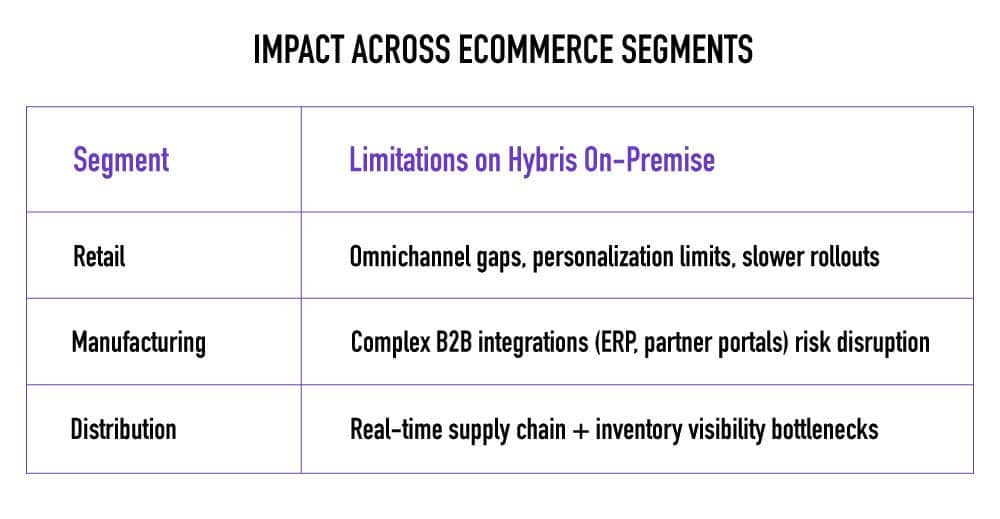
Impact across industries from Hybris end-of-life and operational gaps.
Don’t just ask, “What happens when support ends?” Ask, “Where does my business feel that pain the most?” Retailers will point to customers. Manufacturers will point to systems. Distributors will point to data flow. That’s the starting point for planning a transition.
What Options Do eCommerce Businesses Have After Hybris On-Premise?
With Hybris on-premise support ending, leadership teams have only two viable paths: moving to SAP Commerce Cloud or considering a platform like Adobe Commerce. Each choice comes with clear advantages and trade-offs.
- Stay on Hybris: Yes, the system can continue to run. However, there will be no real updates, only limited fixes, and more costs to keep it stable. Security and compliance will only get harder. This is a short-term option, not a strategy.
- Shift to Adobe Commerce: Adobe Commerce, built on Magento, gives flexibility and freedom. It is particularly suited for businesses seeking to manage the customer experience and marketing layer. The ecosystem is broad, and customization is easier. The trade-off is that integration with SAP’s back-end is possible, but often tailored to business needs. Companies not locked into SAP will find it more attractive than those that are.
- Move to SAP Commerce Cloud: For companies already deep into SAP systems, this makes sense. Commerce Cloud is designed to connect with SAP ERP and CRM. It offers stability, predictable upgrades, and a familiar vendor relationship. The downside is migration effort. It is not a simple move – in many cases, businesses will need to re-architect parts of their platform.
The decision is not just about software. It is about where the business sees itself in the next five years – tightly integrated with SAP, or operating with more flexibility around customer engagement.
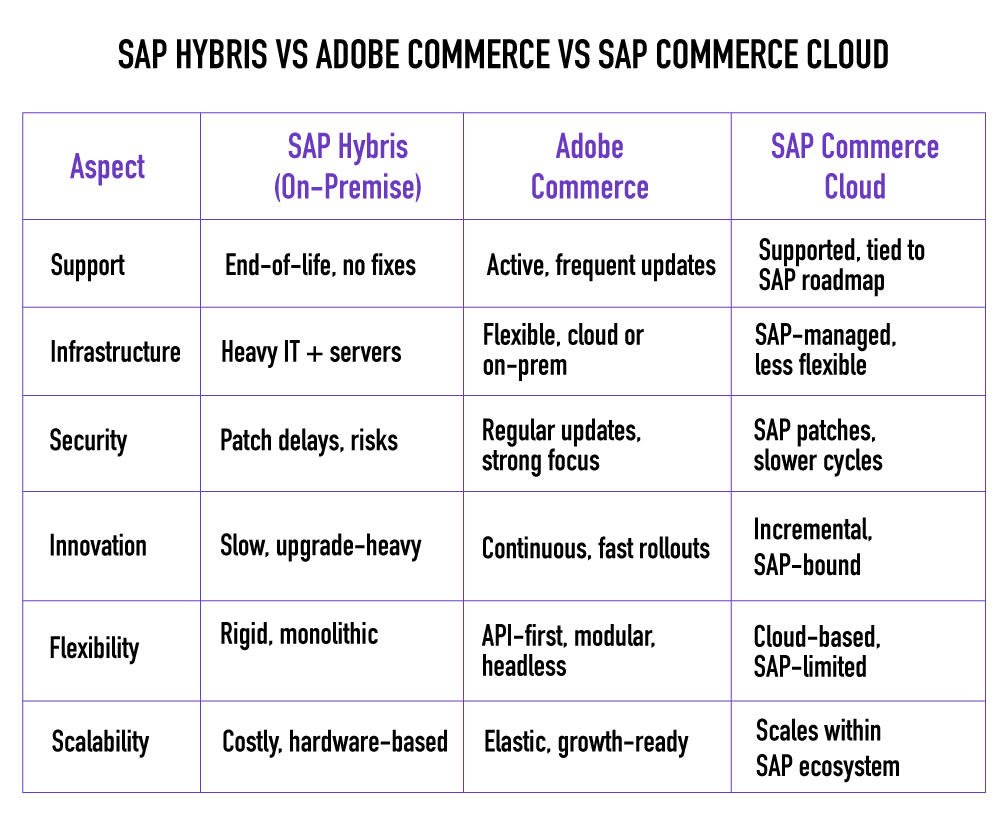
Clear feature differences between SAP Hybris, SAP Commerce Cloud and Adobe Commerce platforms.
What Factors Should Guide the Next Step After Hybris?
When companies weigh their options after Hybris, it is not only about comparing features. The real decision is about how the business operates today and how it wants to compete over the next five years. Four areas often make the difference.
- Total cost of ownership: Licenses are only the starting point. Training, integrations, and the cost of skilled talent all matter. Adobe Commerce often proves more cost-effective over time because of its larger talent pool and flexibility. SAP Commerce Cloud can add overhead since it relies on specialized SAP expertise.
- Integration with existing systems: Businesses that rely heavily on SAP ERP or CRM will find Commerce Cloud a natural fit. For companies with a more mixed technology landscape, Adobe Commerce connects more easily with a wide range of third-party tools.
- Flexibility in customer experience: Many businesses grow by shaping better customer journeys. Adobe Commerce supports this with strong personalization and marketing capabilities. SAP Commerce Cloud is better for companies that prefer standardization and consistency within SAP processes.
- Scalability and innovation: Both platforms scale, but in different ways. Commerce Cloud follows SAP’s upgrade path and roadmap. Adobe Commerce offers greater flexibility to test new ideas and bring them to market more quickly.
There is no one-size-fits-all choice. Companies deeply tied to SAP will find Commerce Cloud the safer move. For most organizations seeking flexibility, speed, and enhanced customer engagement, Adobe Commerce is the stronger option.
How Should Businesses Plan a Smooth Transition?
A move away from Hybris on-premise is not just an IT project. It touches operations, customer experience, and long-term competitiveness. Companies that succeed approach the transition with a structured plan.
- Assess the current system: Start by mapping out what Hybris supports today – catalogs, integrations, custom modules, and workflows. Knowing dependencies is critical before planning migration.
- Define business priorities: Some organizations need speed. Others focus on scalability or improving customer experience. These priorities should guide whether SAP Commerce Cloud or Adobe Commerce is the better fit.
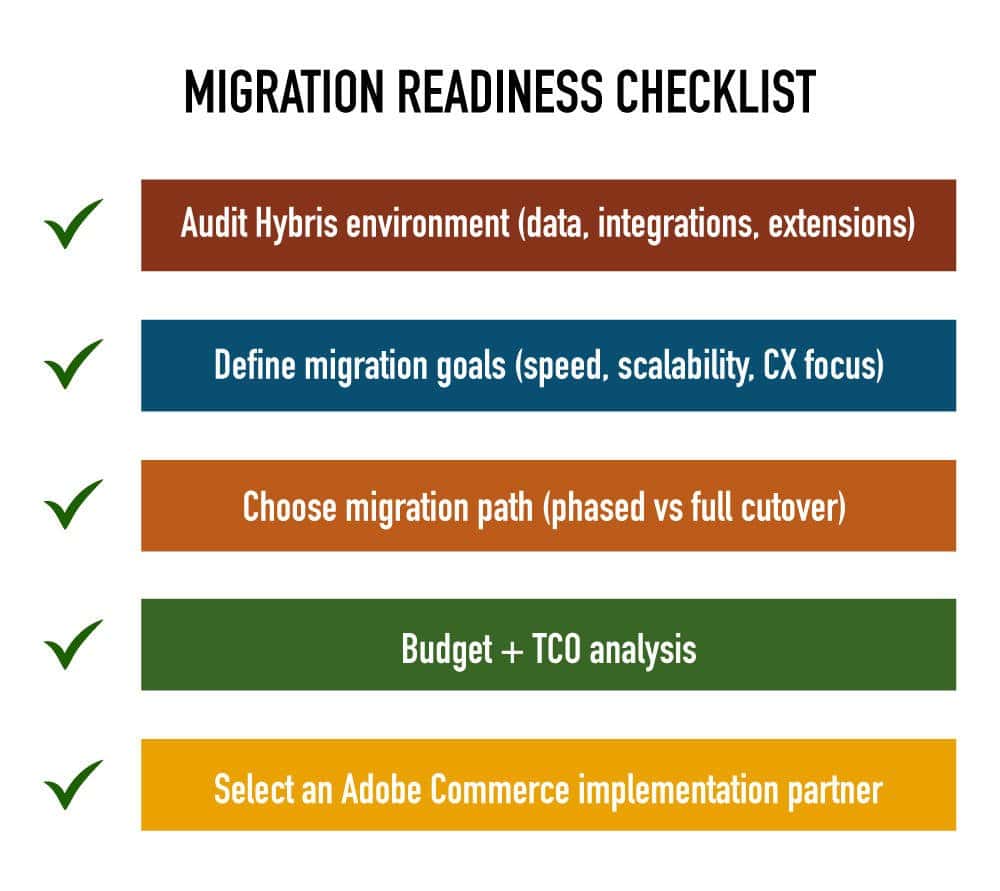
Assess business, data, integrations, and vendor readiness before migrating platforms.
- Choose migration strategy: A phased migration reduces risk but takes longer. A complete cut-over is faster but higher risk. The decision depends on your tolerance for disruption and the resources available.
- Select the right partner: Neither SAP Commerce Cloud nor Adobe Commerce is a plug-and-play platform. The right implementation partner makes a difference in cost, speed, and long-term stability.
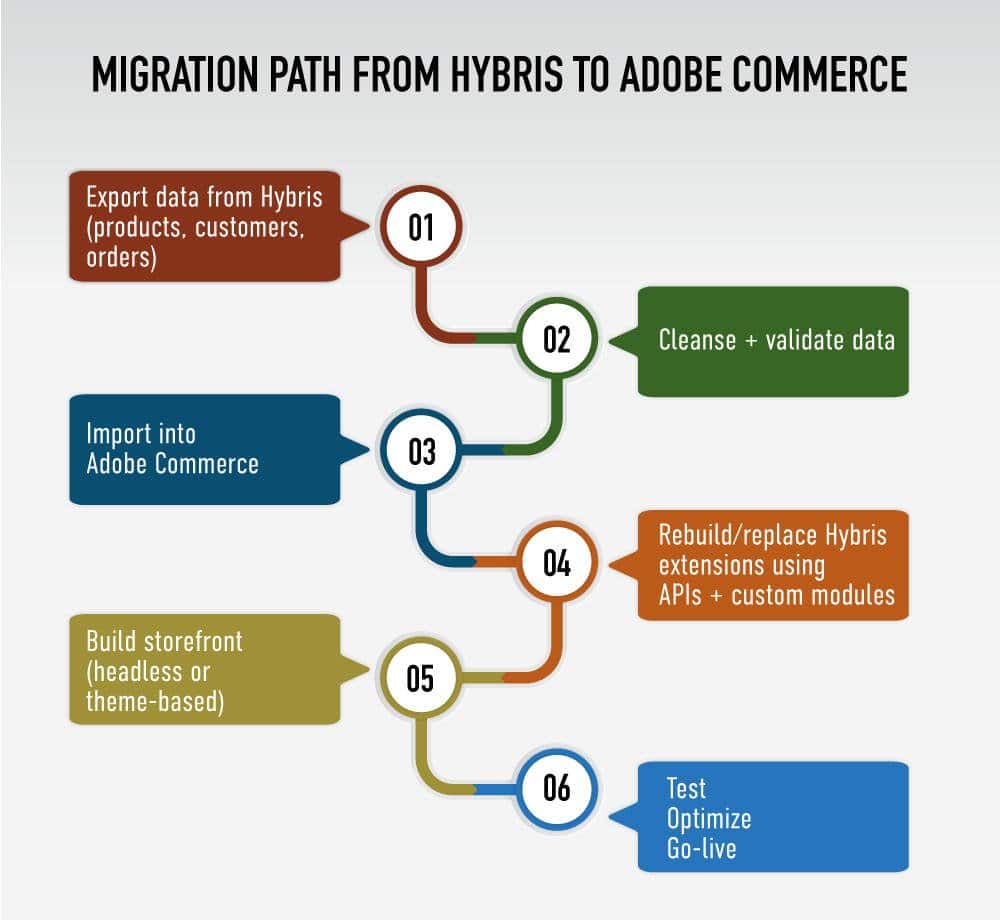
Export, cleanse, import, rebuild extensions, then test and go-live.
Treat this as a business transformation project, not only a technical upgrade. Planning should be led by business priorities, with IT and operations working together from day one.
What are the post-migration benefits with Adobe Commerce?
For many organizations, migration is the hardest step. Once it is complete, the value of Adobe Commerce becomes clear. The platform is built for enterprises that need speed, flexibility, and reliability in a market where customer expectations change constantly. Instead of managing heavy infrastructure, companies can shift attention to strategy, innovation, and growth.
Core benefits include:
- Faster innovation cycles – Enterprises can roll out new features and services quickly, keeping pace with customer demands.
- Modular, API-first architecture – Integration with CRM, ERP, and external systems is simplified, reducing time and cost.
- Headless storefront flexibility – Brands gain freedom to design and deliver experiences across websites, mobile apps, and new digital channels.
- Regular updates and deployments – Security and performance are maintained on a predictable schedule, minimizing business disruption.
- Lower infrastructure and maintenance burden – Cloud-native operations reduce overhead, allowing IT teams to focus on projects that add value.
- Scalable to global operations – The platform supports expansion across multiple regions, currencies, and languages without complex rework.
- Personalized omnichannel CX – Customer journeys can be unified across online and offline touchpoints, improving retention and loyalty.
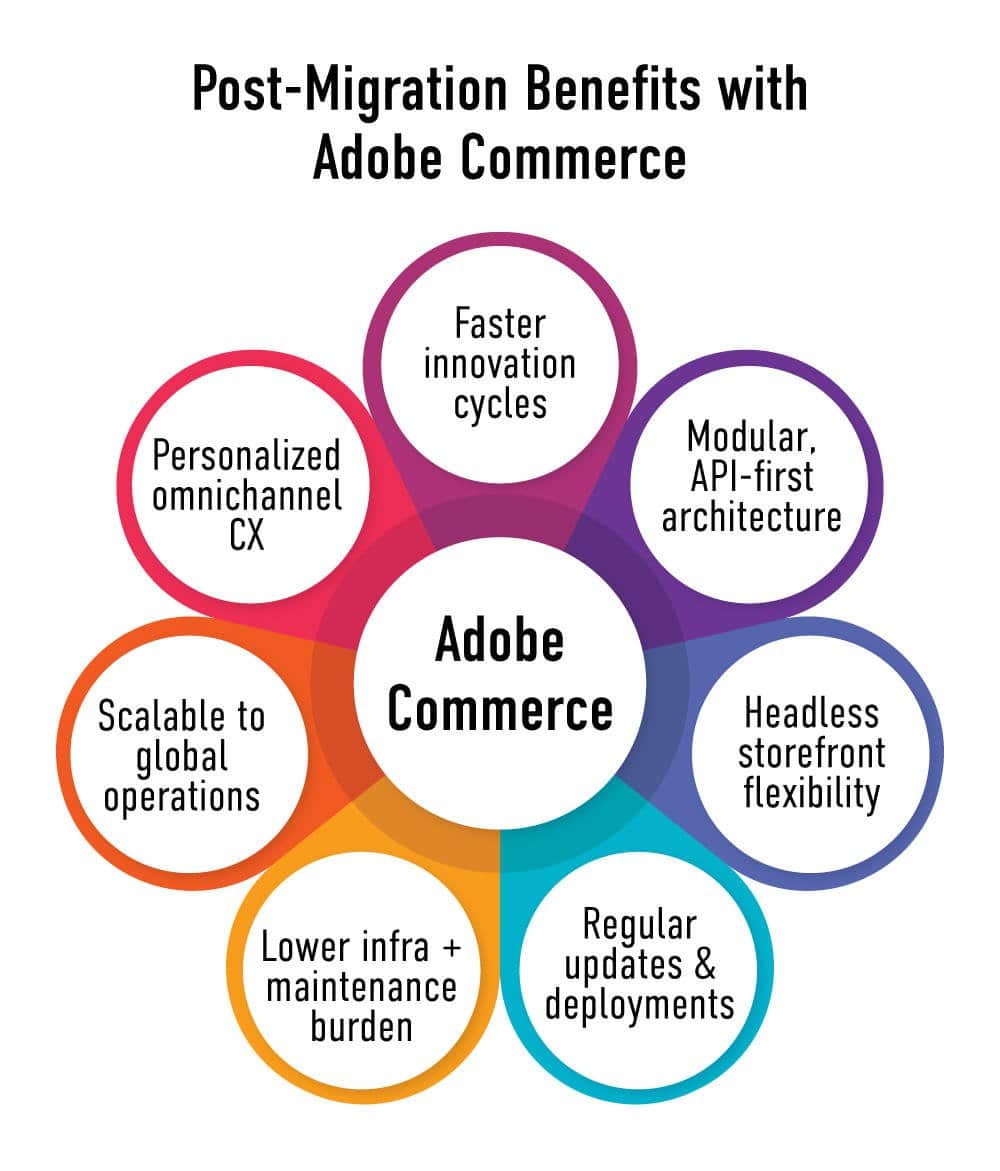
Faster innovation, scalable operations, improved personalization, and lower maintenance costs.
Each of these advantages reduces friction in day-to-day operations while enabling long-term competitiveness. For executives, the key takeaway is straightforward: Adobe Commerce creates a digital foundation that scales with the business, lowers risk, and supports innovation at speed.
What Should eCommerce Leaders Do Next?
The end of SAP Hybris on-premise support is not a distant concern. It is happening now, and every eCommerce business relying on it must respond. The risks of staying on an unsupported system from security vulnerabilities to rising maintenance costs grow sharper with each passing year.
The choice between SAP Commerce Cloud and Adobe Commerce depends on business priorities. Companies deeply invested in SAP’s ecosystem may lean toward Commerce Cloud, while those seeking flexibility and stronger marketing-driven experiences may find Adobe Commerce a better fit. There is no single “right” answer, but there is a wrong one: standing still.
At Ziffity, we help businesses evaluate, plan, and execute these critical moves. Whether you are considering Adobe Commerce or SAP Commerce Cloud, our team can provide the strategic and technical expertise to ensure a smooth migration.
Talk to Ziffity today and take the first step toward a modern, future-ready commerce platform.