
A college student in Arizona decided to buy running shoes. He searched for “best running shoes under $60.” The results looked fine at first. Familiar brands and lots of choices. He opened a couple of tabs and skimmed reviews.
After a while, it stopped feeling clear. Everything looked similar and nothing stood out. He paused. Sat there for a bit. Then just closed the laptop and didn’t buy anything.
This happens more often than we admit. Not because there are too few choices, but because there are too many and no clear way to decide. Research from McKinsey & Company shows that 71% of consumers expect personalized experiences, yet many still struggle with irrelevant results.
For most eCommerce businesses today, the problem is no longer traffic—it is helping users decide.
eCommerce solved availability. It did not solve decision-making. That is where AI shopping assistants are starting to change how people buy.
Most users no longer want to search like this. They expect clear answers. They want to type a question and see the right product fast. This change is forcing eCommerce platforms to improve how search works.
AI shopping assistants are designed to solve this problem. These tools help users find products faster and they also help compare options and make confident choices. Users can ask in normal language. They do not always need to rely on filters or exact keywords.
The system understands intent and retrieves relevant matches using ranking and recommendation models, which is why companies using AI-driven personalization generate up to 40% more revenue than average players.
Large eCommerce platforms are already adding AI into search and product pages. Many stores now use AI to guide the buyer step by step. This makes shopping feel less like browsing and more like getting help from a salesperson.
Search is evolving to include conversational interfaces alongside filters and keyword-based search. Users can ask questions. They can refine the request. They can ask for better options. The system keeps the context and updates the results.
This shift is already visible across modern eCommerce experiences, with shopping moving from search to conversation.
This article explains the most trusted AI shopping assistants used today. Only tools already used on real eCommerce platforms and marketplaces are included. The focus is on systems that work in real stores, not experiments.
What is an AI shopping assistant?
AI shopping assistants are software tools that help users find and buy products using normal language. The user can ask a question. The system understands the meaning. It searches product data and shows the best results with suggestions and comparisons.
Old eCommerce search works with keywords. If the user types the wrong word the results are poor. AI assistants try to understand the intent. A user can describe what they need in a full sentence. The system checks many types of data before showing results.
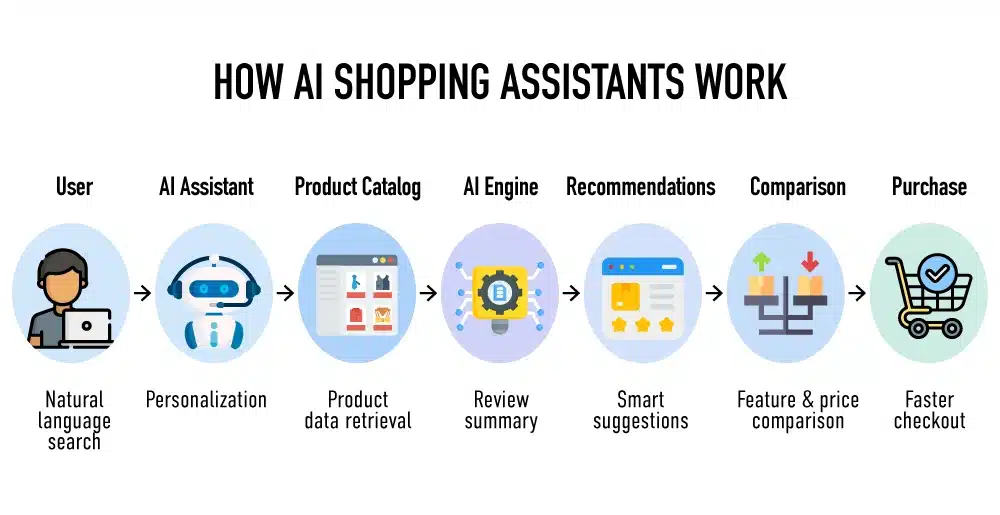
Shows how AI processes queries and delivers accurate recommendations
These assistants use different sources at the same time.
- Product catalog details
- Customer reviews and ratings
- Price and stock data
- User history and preferences
- Store rules and product ranking
Because of this the results feel guided. They do not look random.
Another change is conversational shopping. The user can ask again and again. Each question makes the result better. The system maintains session context or conversation state to refine results. This makes the search feel natural.
AI can also read reviews and give a short summary. Users do not need to read hundreds of comments. Many assistants can compare products and explain the difference in simple words.
It is important to see the difference between chatbots and AI shopping assistants. Chatbots are typically rule-based or FAQ-driven, while AI shopping assistants use LLMs and retrieval (RAG) to provide context-aware recommendations.
This is why AI shopping assistants are now part of modern eCommerce platforms. They are no longer only support tools. They are used to guide the full buying process.
Why are AI shopping assistants becoming popular?
AI shopping assistants are becoming popular because online stores have too many products. Users do not want to search page by page. AI shows the best matches fast, gives personal suggestions, and makes buying easier. Stores use AI to increase conversions and improve user experience.
Online stores now have very large catalogs. Even a small search can return hundreds of results and users get tired of scrolling. They open many tabs and still feel unsure. This makes manual shopping slow and frustrating.
AI assistants reduce this problem. The user types what they need. The system finds the closest matches in seconds. Sorting is typically rule-based or filter-driven, while AI primarily influences ranking and relevance scoring. This saves time and removes guesswork.
Personalization is another reason for growth. AI looks at past searches, past orders, and user behavior. Based on this data the system suggests products that fit the user. The results feel more accurate. Users do not need to start from zero each time.
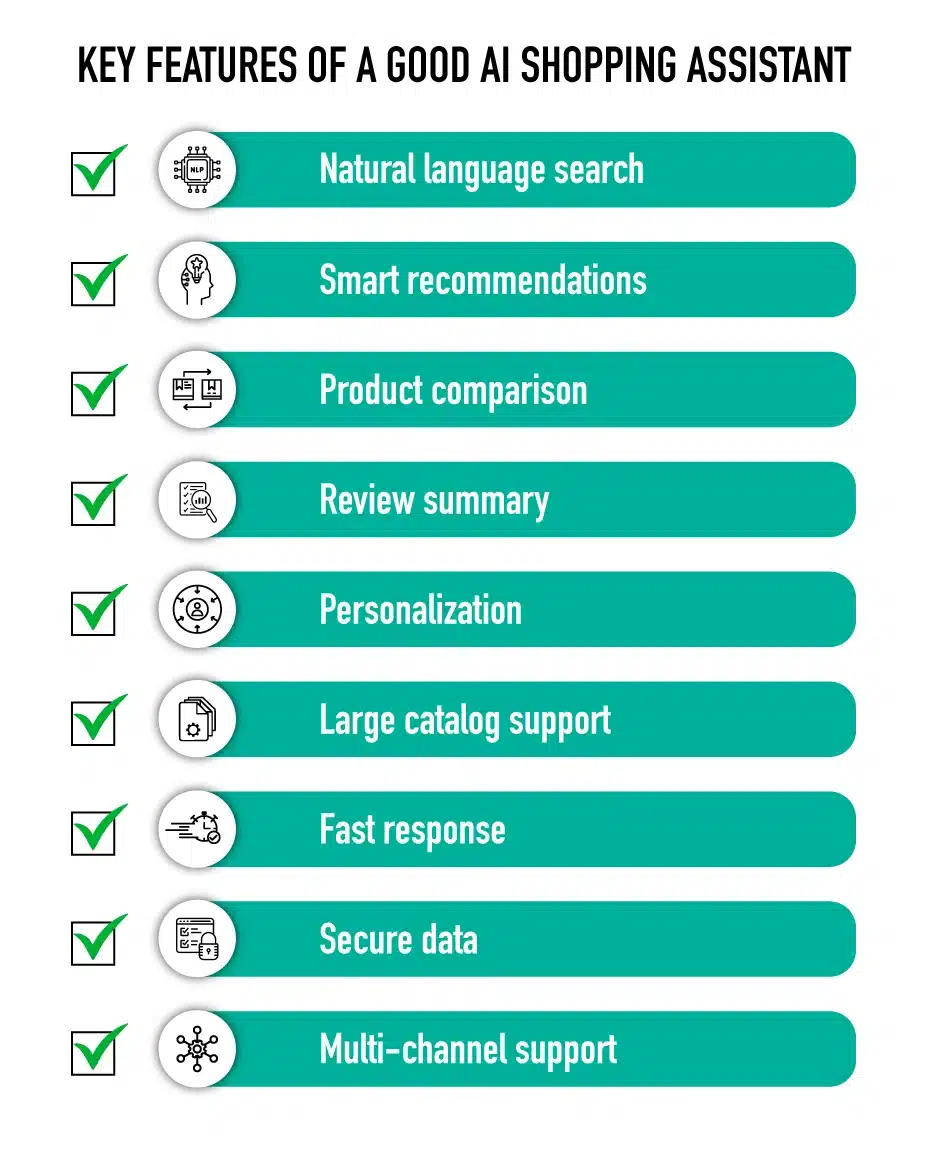
Checklist of essential features for effective AI shopping assistants
Many stores use AI like a virtual salesperson. The assistant can guide the buyer step by step. It can suggest better options. It can show related products. It can explain the difference between two items. This makes the shopping process smoother.
Many stores use AI like a virtual salesperson. The assistant can guide the buyer step by step. It can suggest better options. It can show related products. It can explain the difference between two items. This makes the shopping process smoother.
eCommerce companies also use AI to increase conversion rate. When users find the right product faster they are more likely to buy. Good recommendations reduce drop-offs. This directly improves revenue.
Conversational search is another reason for popularity. Users can type full questions instead of short keywords. The system understands the meaning and gives better results. This feels more natural than using filters.
Shopping is not just about showing results anymore. It is about guiding decisions through conversation.
Modern shoppers expect quick answers. They do not want to read long lists. They want instant suggestions. AI shopping assistants make this possible, which is why they are becoming common in eCommerce stores.
Adding a chatbot interface does not automatically improve conversion. Without relevance and accuracy, conversational UX can increase friction.
Key takeaway:
AI shopping assistants shorten decision time and increase conversions by improving relevance and reducing search effort.
What types of AI shopping assistants exist today?
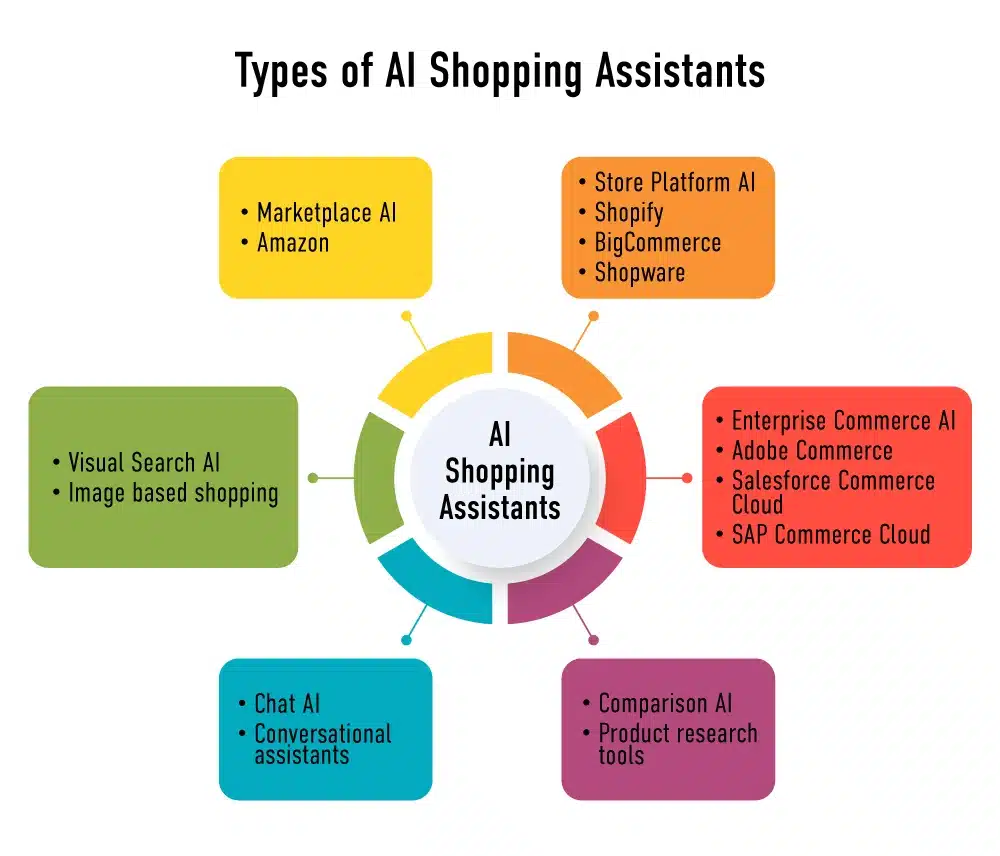
Breakdown of AI assistant categories across eCommerce platforms
There are different types of AI shopping assistants used in eCommerce today. Some are built into marketplaces. Some are part of eCommerce platforms. Some compare products across websites. Others work as chat tools or enterprise retail systems.
One common type is marketplace AI assistants. Large marketplaces integrate AI into their search. These assistants help users find products faster inside the same platform. They can answer questions and summarize reviews.
Another type is eCommerce platform assistants. Platforms such as Adobe Commerce, Shopify, Shopware, and BigCommerce include AI features, often through a mix of native capabilities and third-party integrations. These assistants help with search, recommendations, and product discovery. They are used by store owners to guide customers.
There are also comparison AI tools. These tools aggregate data via APIs or scraping and may face limitations in data consistency, freshness, and access. They help users check prices, features, and reviews from different stores. This is useful when the buyer does not want to stay inside one marketplace.
Some assistants work as browser tools or chat tools. The user can type a question while browsing. The tool suggests products from different sites. This makes shopping faster without opening many tabs.
Another growing type is visual search assistants. Users can upload a photo or screenshot. The AI finds similar products. This is common in fashion, furniture, and electronics where users may not know the product name.
There is also a difference between consumer tools and enterprise tools.
Consumer tools help buyers search products.
Enterprise tools help stores guide buyers.
Both are part of modern eCommerce, and both are driving the growth of AI shopping assistants.
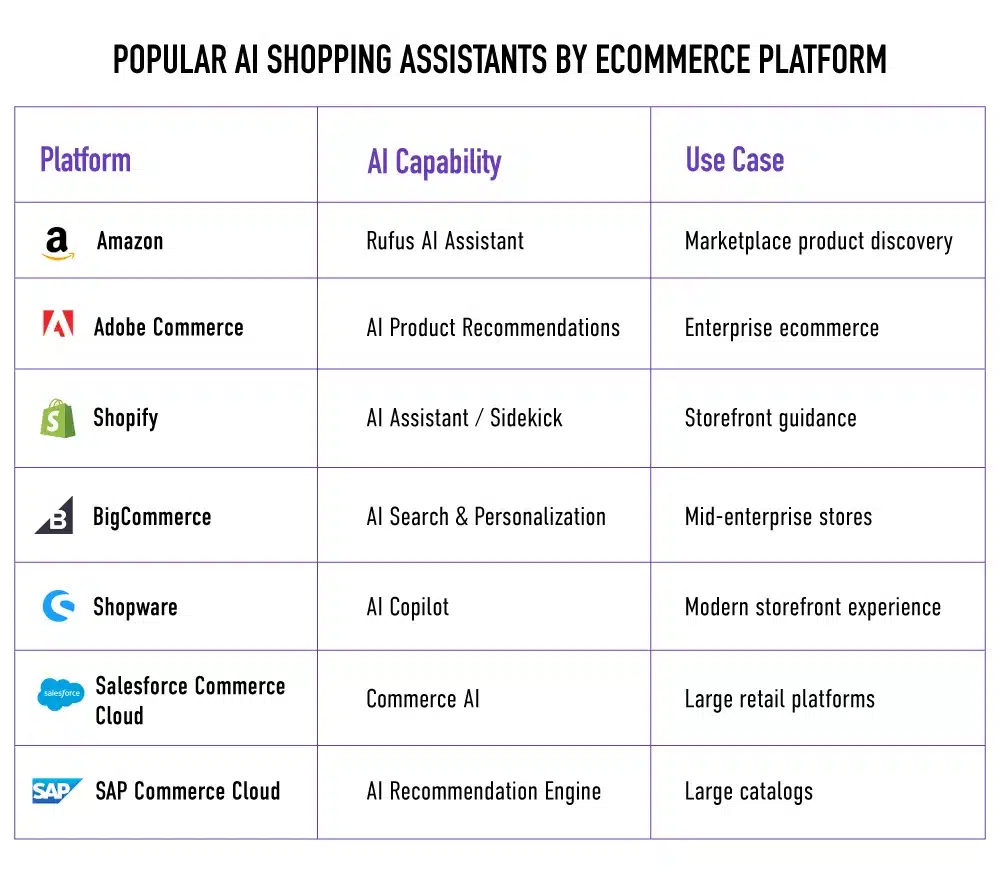
Compares AI capabilities across leading ecommerce platforms
What are the top AI tools used in modern eCommerce platforms?
AI is now a built-in part of most eCommerce systems, helping stores manage large catalogs, improve search, and guide customers more effectively. Different platforms offer different AI capabilities depending on their scale and design. Below are seven AI tools used across leading eCommerce platforms to improve discovery, personalization, automation, and performance.
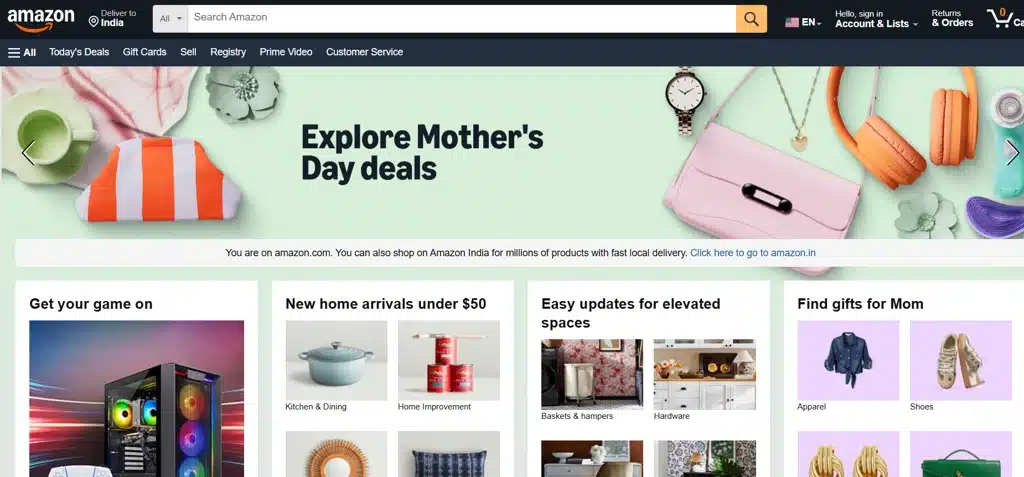
Amazon Rufus
What it is
Amazon Rufus is an AI shopping assistant within the Amazon marketplace. It lets users ask questions, compare products, and understand reviews. Using product data and customer feedback gives direct answers. It also helps people find products more quickly.
How it works
Amazon introduced Rufus to help users spend less time searching. Rather than using short keywords, people can ask full questions. The assistant checks product details, ratings, and reviews before showing results, so its suggestions are more accurate.
Rufus can also sum up reviews, so users do not have to read many comments. It highlights the main pros and cons in clear language, making it easier to decide.
While browsing, Rufus suggests similar items, cheaper choices, higher-rated products, or related accessories. It also helps compare products by looking at specifications, reviews, and prices before giving an answer.
Key features
- AI shopping assistant inside marketplace
- Review summaries
- Product comparison support
- Contextual recommendations
- Faster product discovery
Adobe Commerce AI
What it is
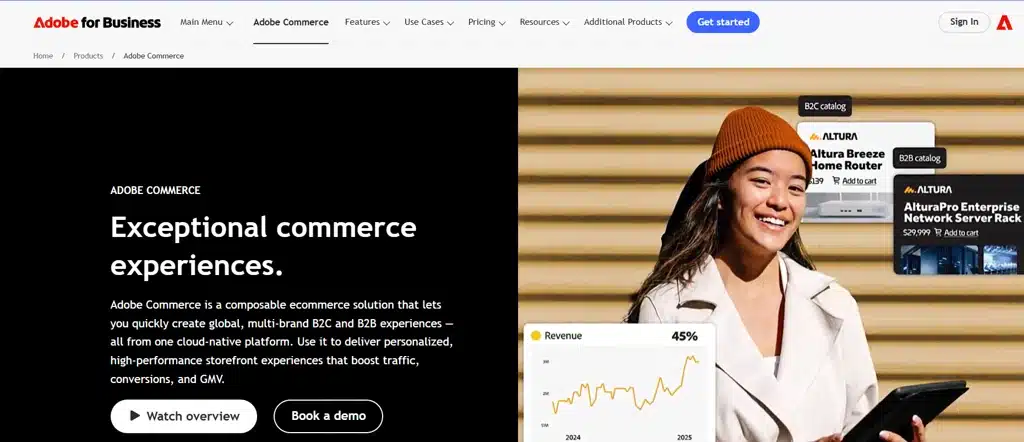
Adobe Commerce AI provides intelligent search, recommendations, and personalization inside eCommerce stores. The system understands user intent, analyzes catalog data, and shows the most relevant products. This helps large online stores guide buyers and improve conversion rate.
How it works
AI features are built into search and merchandising. The system studies product data, customer behavior, and store rules to decide which products should appear first.
AI-powered search is important for large catalogs where keyword search is not enough. The system understands meaning, not only words, which gives better results.
Recommendations are generated automatically based on user behavior, product data, and store rules. Personalization allows different customers to see different products based on their history and preferences.
Key features
- AI catalog search
- Automated recommendations
- Customer personalization
- Merchandising intelligence
- Enterprise catalog support
Shopify AI Assistants

What it is
Shopify AI assistants help customers browse products, get suggestions, and find answers inside the storefront. The system can automate support, recommend products, and guide the buyer step by step. This allows small and medium stores to provide a better shopping experience.
How it works
Shopify includes AI tools for search, recommendations, and chat support. Store owners can enable these tools without building custom systems.
Customers can ask questions in normal language and get matching products. AI can also answer common questions, reducing the need for manual support.
Store owners can control recommendations using rules, promotions, bundles, and upgrades. Personalization allows different suggestions for new and returning customers.
Key features
- Built-in AI tools
- Natural language search
- Automated support
- Product recommendations
- Easy setup for stores
BigCommerce AI

What it is
BigCommerce provides AI tools for search, recommendations, and personalization. The platform also supports integration with external AI systems, making it suitable for growing and enterprise eCommerce stores.
How it works
Search tools rank products by relevance and user behavior, helping people find items more quickly.
Recommendation engines suggest related products or items that are often bought together, which can help increase order value.
The platform supports external AI integrations for advanced personalization and automation. It is built to handle large catalogs and high traffic without slowing down search.
Key features
- AI search ranking
- Recommendation engine
- External AI integration
- Scalable catalogs
- Enterprise performance
Shopware AI
What it is
Shopware has AI tools for search, recommendations, and storefront automation. These features help users find products faster and help merchants manage large catalogs. The system is made for modern eCommerce stores that need flexible ways to discover products.
How it works
Shopware AI improves search by understanding what users want, not just matching keywords. This makes it easier to navigate the store.
The platform can generate product recommendations based on behavior, popularity, or store rules. Automation can also help organize products and improve search ranking.
Shopware works well with headless commerce and custom frontends, allowing AI features to be added without changing the full system.
Key features
- Intent-based search
- AI recommendations
- Storefront automation
- Headless support
- Flexible architecture
Salesforce Commerce Cloud AI

What it is
Salesforce Commerce Cloud uses AI to guide users through the shopping process using personalization, recommendations, and guided selling. It works across web, mobile, and store channels, making it suitable for large brands with complex eCommerce needs.
How it works
The system studies browsing history, past orders, and customer data to personalize product suggestions.
Guided selling allows the assistant to ask questions and suggest products step by step, which is useful for large or technical catalogs.
AI recommendations appear across the store, including related products, upgrades, and accessories. The same AI can work across multiple channels to keep the experience consistent.
Key features
- Guided selling
- Customer personalization
- Omnichannel AI
- Real-time recommendations
- Enterprise scale support
SAP Commerce AI
What it is
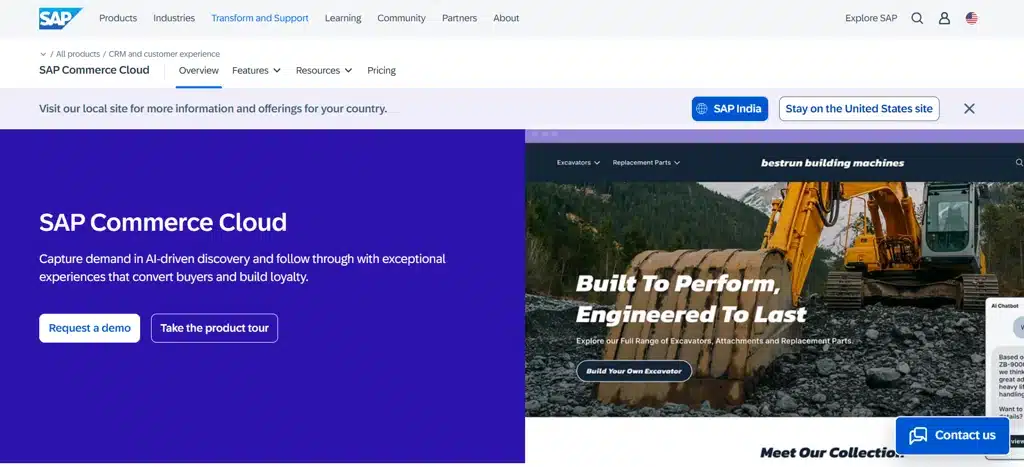
SAP Commerce AI provides intelligent search, recommendations, and personalization for very large eCommerce systems. It connects product data, customer data, and business rules to manage complex catalogs.
How it works
AI organizes search results so users can find products quickly even in very large catalogs. The system understands intent and shows relevant items.
Recommendation engines use customer behavior and product data to suggest similar items, upgrades, or frequently bought products.
SAP can integrate with customer data platforms, inventory systems, and pricing systems, allowing AI to make better decisions based on business rules.
Key features
- Large catalog search
- Recommendation engine
- Deep system integration
- Rule-based personalization
- Enterprise commerce support
What will the future of AI shopping assistants look like?
The future of AI shopping assistants will move from search to conversation. Users will not browse long lists. They will ask what they need. AI will understand the request, find the best option, and guide the purchase. Shopping will feel more like talking than searching.
This shift is not about interface alone. It depends on how well systems understand intent and deliver accurate results.
Search-based shopping is slowly changing. In the past users typed keywords and checked results one by one. Now users ask full questions. AI understands meaning and context. This makes product discovery faster and more natural.
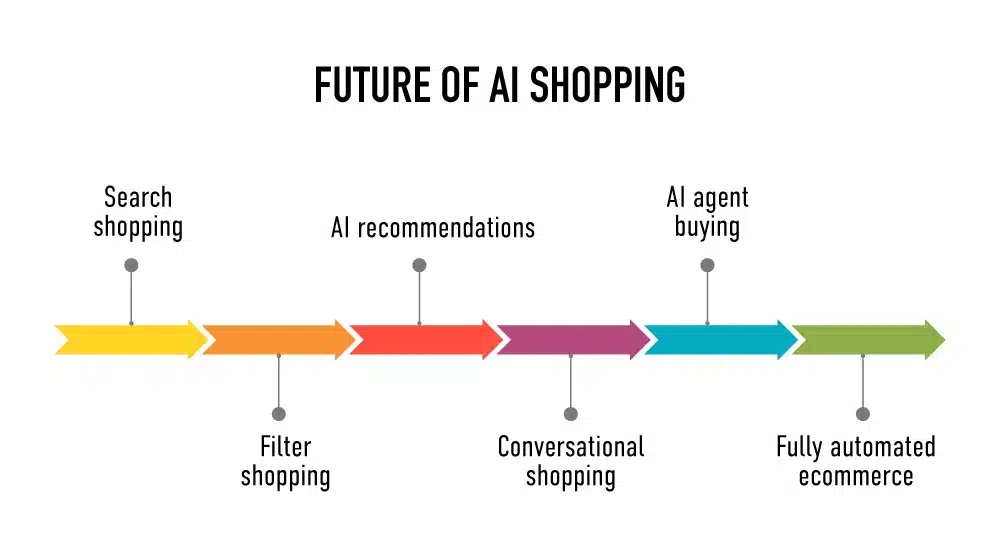
Timeline showing shift from search to automated buying systems
Agentic AI is also emerging in eCommerce. Instead of only suggesting products, the assistant can complete tasks. It can find items, compare prices, and prepare the order. In some cases it can even place the order after confirmation. This reduces effort for the buyer.
Voice shopping and mobile assistants will also increase. Many users already speak to their phones instead of typing. AI assistants can understand voice commands and show results instantly. This makes shopping possible without opening many pages.
Real-time personalization will become stronger. AI will adjust results while the user is browsing. It will change recommendations based on behavior, location, and past orders. Each user will see a different store experience.
Auto-buy and smart recommendations will also grow. The system may suggest products before the user searches. It may remind users to reorder items. It may show upgrades at the right time.
AI will also connect deeper with eCommerce platforms. Search, catalog, pricing, and customer data will work together. This will make the shopping experience faster and more accurate.
In the future, eCommerce will not depend on manual search. It will depend on intelligent assistants that guide every step.
Why are AI shopping assistants becoming part of modern eCommerce?
AI shopping assistants are growing because online shopping has become too complex. Users want faster decisions and better suggestions. AI helps customers find products quickly and helps stores increase sales. This makes AI assistants important for both buyers and eCommerce businesses.
Product discovery is no longer manual. Large catalogs make browsing slow. AI can read product data, reviews, and user behavior in seconds. This allows the system to show the best options without long searching.
For customers, this means less effort and more confidence. For eCommerce stores, this means higher conversion and better user experience.
Shopping is moving away from manual search. It is moving toward guided decisions.
AI shopping assistants are only as good as the product data behind them. Poor catalogs lead to poor recommendations—no matter how advanced the model is.
In the near future, most online buying will happen with the help of AI assistants, not by scrolling through product lists.
Evaluate your product discovery experience and identify where users struggle to find relevant options or make decisions.