Most distributors measure the cost of a stockout when the shelf is empty, and the order fails.
That’s too late.
The real loss occurs weeks earlier, in the silence. The order is placed. The system shows inventory. No one complains. But your customer—the one running a factory, stocking a retail floor, fulfilling a contract—quietly stops planning around your deliveries.
Their trust shifts before your dashboard flashes red. By the time the stockout is visible in your reports, your position in their supply chain has already been replaced.
Why Do Stockouts Still Hurt Distributor Growth?
Stockouts may seem like minor supply chain issues; however, they cause more harm in the long run. Research shows that retailers lose an average of about 4% of annual sales directly due to stockouts, and in some sectors, this can rise to around 7.4% of total sales lost. If a shipment is late or a product is missing, consumers become concerned. They begin planning manufacturing production, stocking an outlet, or signing contracts based on estimated product arrival levels.
If any single product is late or fails to arrive, loyal customers begin to lose confidence. Most of them will never complain again. In fact, over half of products experience at least one stockout per year, meaning many customers regularly encounter availability failures. They will resort to another supplier.
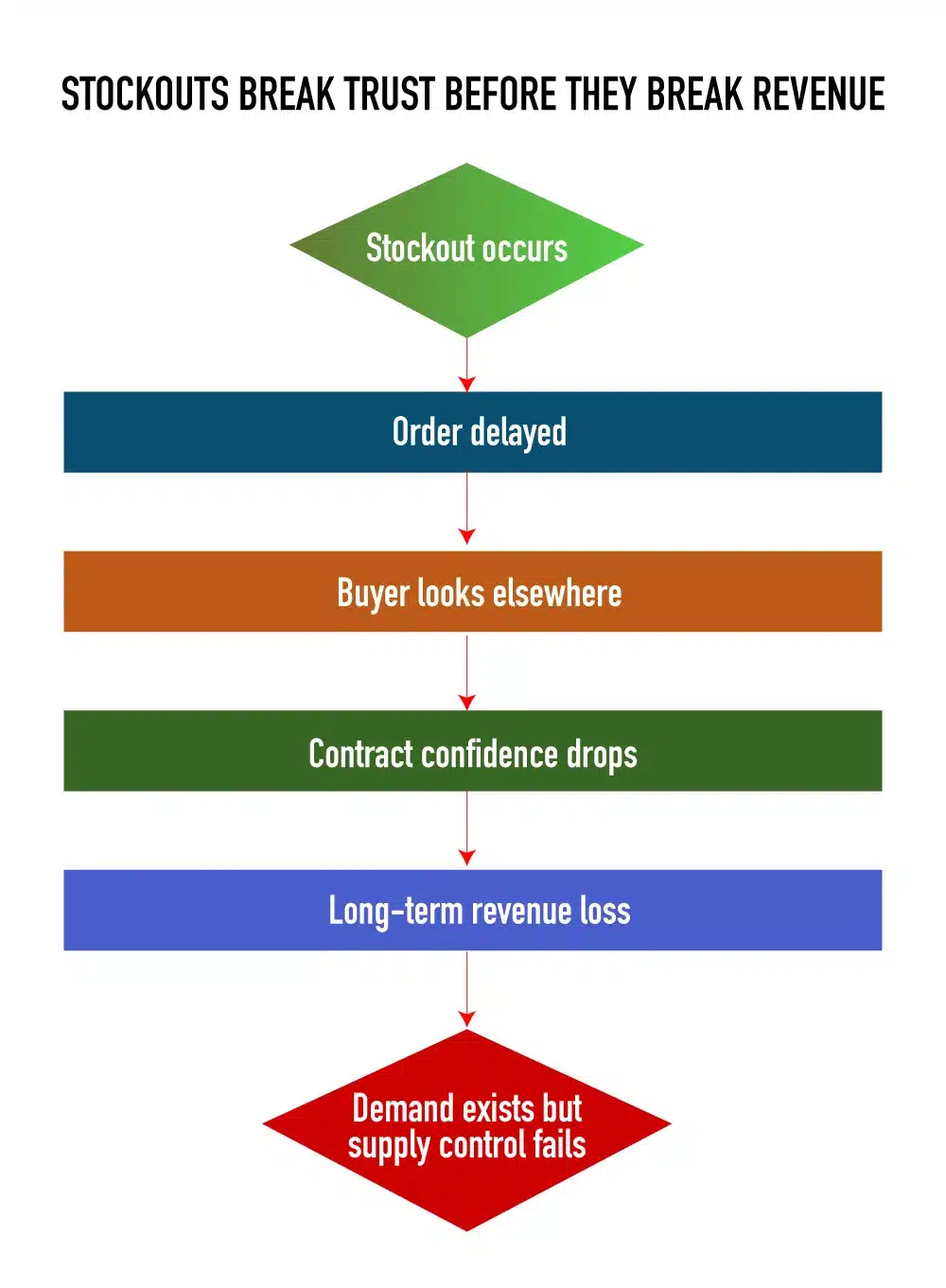
Stockouts create cascading failures across trust, contracts, and revenue
As far as distributors are concerned, demand is not a problem. Orders are still coming in. The problem is identifying where and when problems will occur. Many teams see a problem only after their stock has become zero. That is where there are very few alternatives left. Expedited shipping needs to be done. It becomes more expensive and leaves less room for margins.
To address this type of stock-out risk, distributors are turning to Agentic AI solutions that operate on top of existing enterprise platforms.
Commerceloom is Ziffity’s Agentic AI solution for distributors, bringing together the eCommerce Business Assistant, Inventory Forecast Agent, RFQ to Quote Agent, PO to Order Agent, SEO Optimization Agent, Anomaly Detection Agent, and Accounts Payable Agent to monitor, analyze, and act across ERP and eCommerce operations.
Commerceloom breaks the pattern by highlighting challenges earlier. The eCommerce Business Assistant provides quick responses on sales, inventory, and orders without waiting for reports. Leadership can also ask basic questions concerning pressure building when inventory is running out.
The Inventory Forecast Agent further increases this level of control. It has foresight that extends several weeks, highlighting SKUs that could fall short. Teams can now begin planning inventory flow, and this is where digital transformation services begin to protect revenue.
What changes with Commerceloom
- Demand risk appears before shelves go empty
- Fill rates stabilize without excess inventory
- Teams act earlier, not faster
- Decisions rely on shared signals, not instinct
Why Does Traditional Forecasting Fail at Distribution Scale?
Traditional forecasting is built on a simple belief that what happened yesterday will happen again tomorrow. That assumption breaks as catalogs grow and regions multiply. Spreadsheets updated on a fixed schedule are still used for many forecasts.
Another significant issue is disconnected data. The sales team sees orders. The warehouse receives inventory. The finance department sees results at the end of the month. Each department has a different perspective on the business.
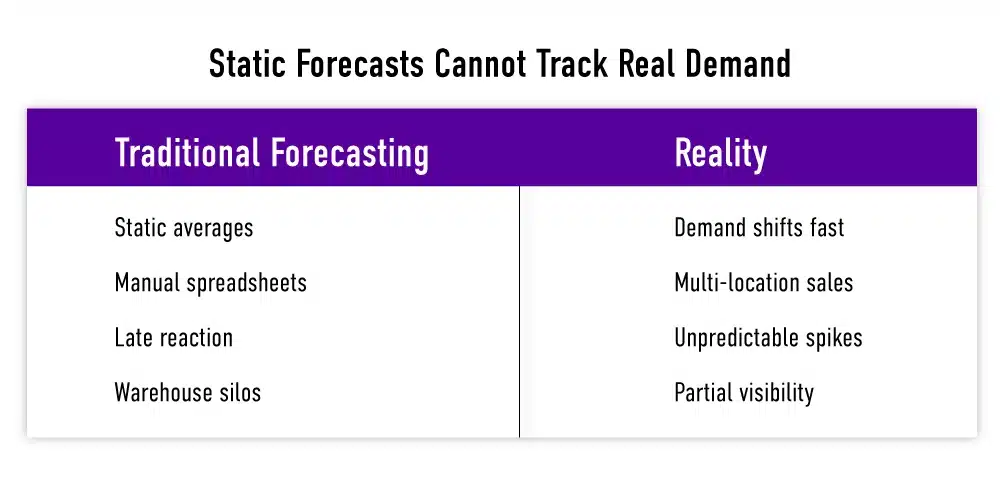
Static forecasting models fail to capture dynamic demand behavior
Commerceloom solves these issues by connecting data between systems. This is accomplished through eCommerce integration services that compile data from eCommerce platforms and ERP systems into a unified view. The eCommerce Business Assistant resolves reporting delays by providing immediate answers to questions.
There is also the added protection provided by the Anomaly Detection Agent. This agent detects spikes or drops in demand as they happen and provides explanations for the anomaly. This gives teams the opportunity to address issues before any damage occurs. Agentic AI services matter here because monitoring never stops.
Where old methods break
- Static averages ignore live demand movement
- Manual updates arrive too late
- Teams operate with partial visibility
- Action starts only after stockouts occur
How Does AI Demand Forecasting Predict Demand Before It Hits?
Demand doesn’t change suddenly, but it changes little by little. Demand can increase in one place while falling in another. This may be due to a seasonal change. This may be because buyers want to make different purchases without notifying anyone. Traditional forecasting methods don’t account for these things. This is because traditional forecasting typically uses historical data. This updates slowly according to fixed schedules. AI demand forecasting is better because it observes demand as it changes.
The Inventory Forecast Agent by Commerceloom considers sales history, seasonal data, promotions, and business indicators simultaneously. It does not break them down into separate pieces of information. It treats them as a single piece of information. The Inventory Forecast Agent makes demand predictions up to 16 weeks in advance. It continues to make new predictions as new information arrives. If consumer buying behaviors change, the predictions will change accordingly.
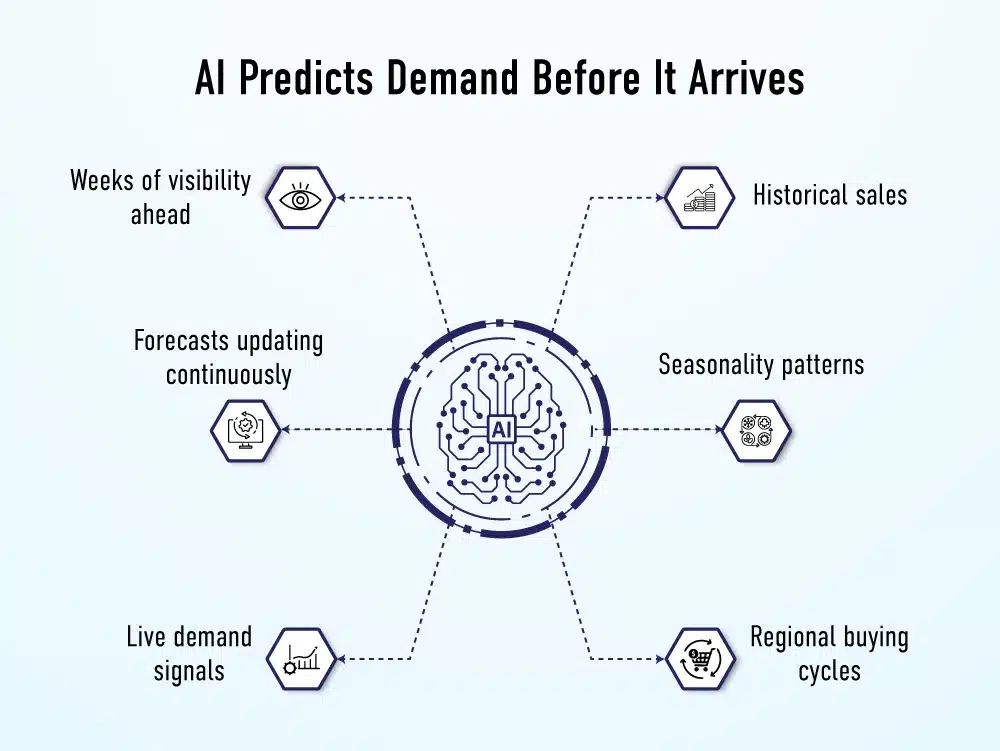
AI consolidates historical and live signals to predict demand
The agent also interprets its predictions. It displays the scores for each prediction, along with the key reasons for a signal. They understand the received signal and its strength. Predictions are no longer a matter of opinion. They are a team resource used every day.
What Commerceloom forecasting enables
- Early visibility into demand shifts
- Region- and SKU-level forecasting
- Continuous updates without manual resets
- Clear confidence scoring for decisions
- Fewer surprises during peak cycles
Forecasting is no longer a monthly process. It will now be a daily benefit that will enable teams to make informed decisions.
How Do Inventory Forecast Agents Turn Predictions Into Stock Decisions?
Forecasts won’t prevent stockouts on their own. Decisions will. Predictions have one purpose: to be transformed into action by forecast agents. The Inventory Forecast Agent by Commerceloom turns demand signals into easily followable inventory decisions.
The agent displays future inventory levels and indicates which SKUs may run out of stock. It also displays other inventory that could be dead stock. Re-order recommendations depend on demand, seasonality, and lead times. There is a reason for all re-order recommendations. Nothing seems to be random here.
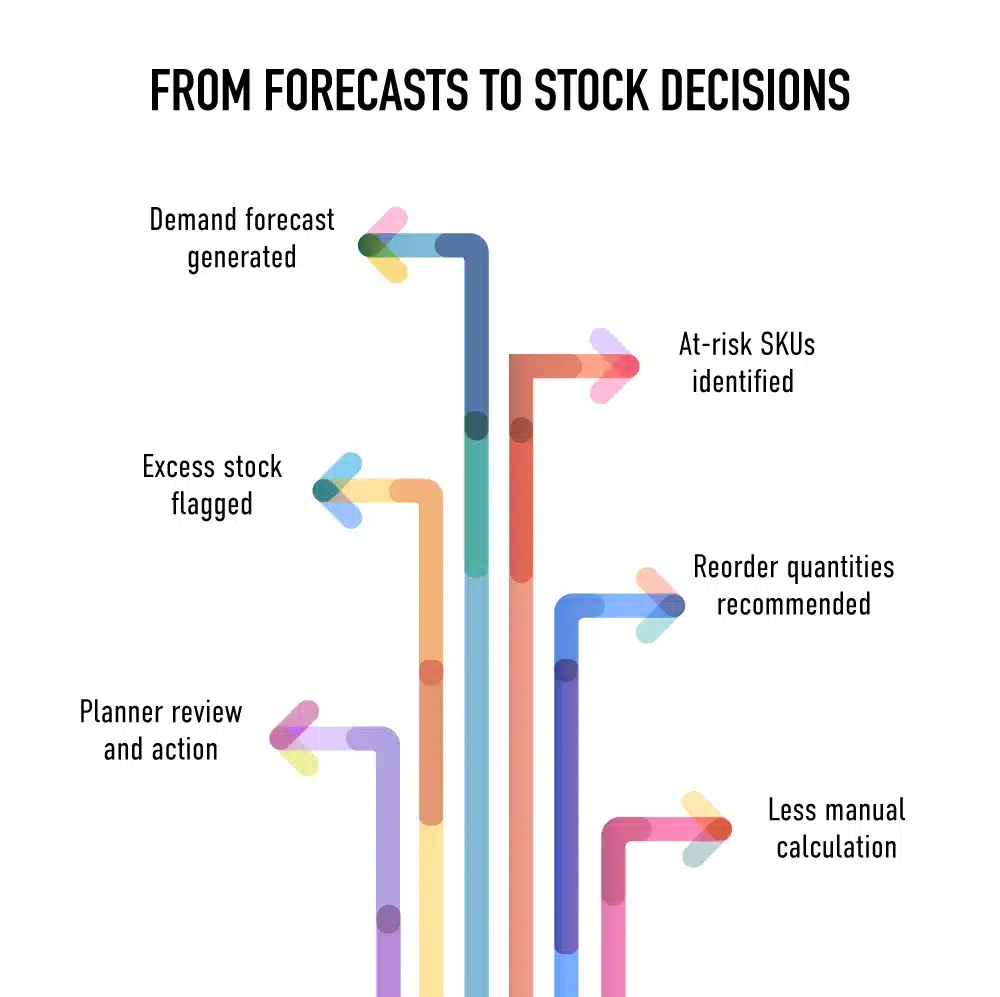
Forecast outputs convert into SKU-level inventory decisions automatically
It’s a radical change for planners. They no longer have to review several hundred SKUs. They worry about the handful that truly impact them, and their review cycles become easier and more predictable. The clock swings away from laborious manual work, even as judgment improves.
This describes the power of control that improved technology brings, not merely faster technology. The agent also supports existing workflows. It integrates with order and purchase systems, enabling decisions to become actions quickly. When combined with the PO to Order Agent, inventory-related decisions are made with fewer mistakes. Misses are eliminated. Delays are reduced.
What inventory agents change
- Clear visibility into future stock risk
- Explainable reorder recommendations
- Reduced manual planning effort
- Better alignment between demand and supply
- More stable inventory over time
How Does Real-Time Inventory Visibility Prevent Hidden Stock Gaps?
Most stockouts are not due to a product having zero stock. This happens when systems become out of sync. One may indicate that the item is in stock. The other may indicate that the item has already been promised out. Teams make sales decisions with outdated numbers. By the time they notice an issue, the order could be in jeopardy.
Commerceloom eliminates this problem by providing teams with real-time inventory visibility across systems. The eCommerce Business Assistant enables teams to query stock status at any time with simple questions. It is not necessary to open a report or dashboard for this process. The same figures are visible to all for entirely different reasons, which helps avoid errors.
This is important when demand fluctuates quickly. A product may be acceptable in the morning but needed by the end of the afternoon. All these changes are evident early through the use of Commerceloom. This is because the Anomaly Detection Agent prevents overselling during periods of rising demand.
Real-time visibility also helps teams work in harmony. Sales knows how much product is safe to sell, and operations know which stock requires attentive monitoring. Leadership understands risk without asking for updates.
What Commerceloom visibility enables
- Live inventory insight across locations
- Early detection of fast-moving SKUs
- Prevention of overselling before checkout
- Shared data across sales and operations
- Faster response without manual checks
How Can Smart Order Allocation Improve Fill Rates Consistently?
Fill rates are affected when orders are placed without much thought. Some software distributes orders to the nearest warehouse. This works only when the inventory is balanced. When inventory is unbalanced, orders may be split, resulting in late delivery.
Commerceloom enhances this by combining inventory levels, order importance, and shipping limitations. Orders go to locations that can ship them in full. Major customers and orders under contract receive priority. Split orders decrease. This reduces costs and saves time.
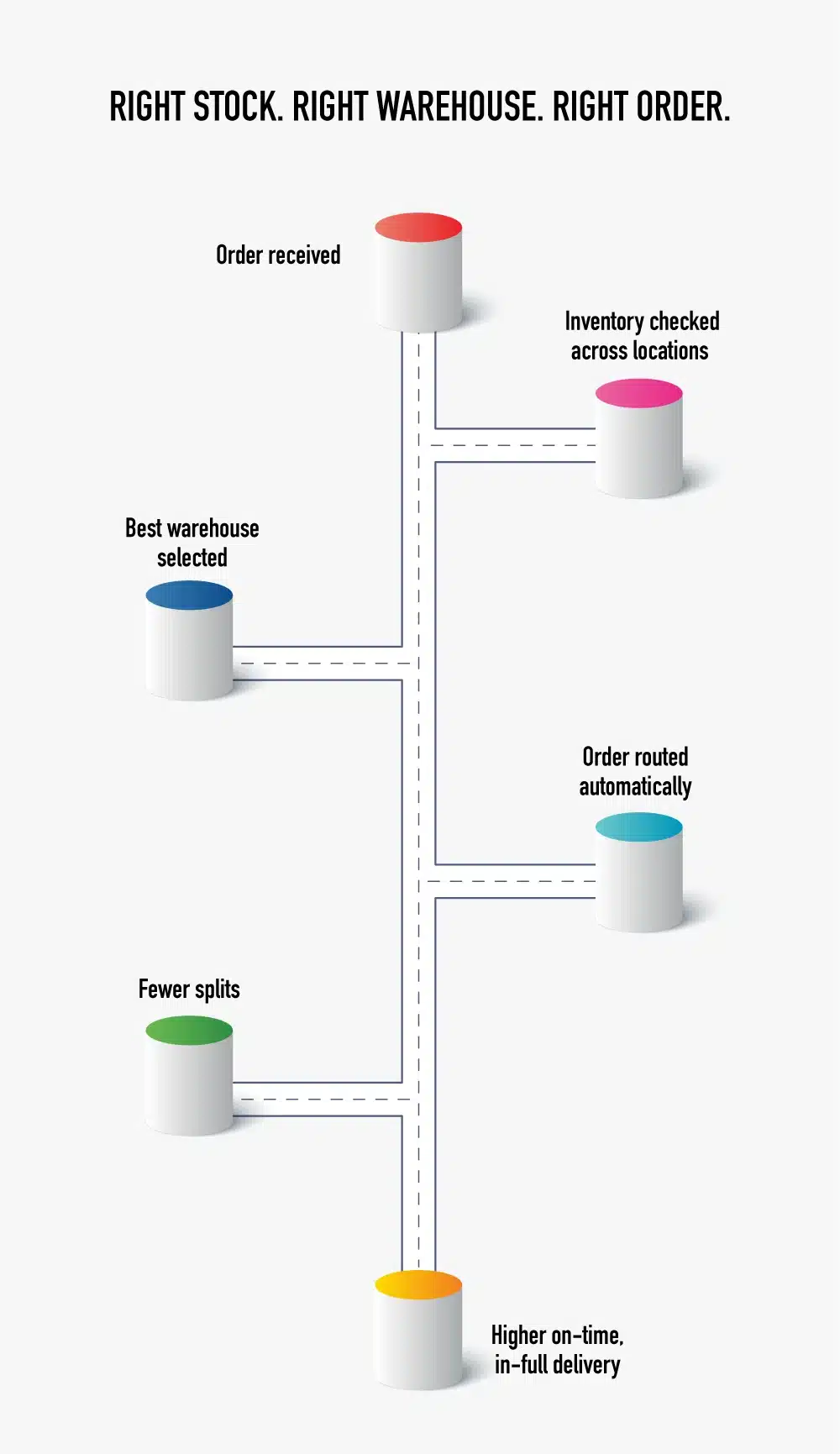
Intelligent allocation improves fill rates and on-time fulfillment consistency
The eCommerce Business Assistant further clarifies why an order was delivered to a certain location. This builds trust among teams in the system. When teams understand why an order was delivered in a certain way, manual interventions are reduced.
Over time, outcomes remain consistent. Clients receive complete orders. Teams spend less time resolving issues. Fill rates increase as a result of better decisions made ahead of order fulfillment.
What smart allocation improves
- Higher on-time and in-full delivery
- Fewer split shipments
- Better use of available stock
- Priority handling for key accounts
- Stable service levels across regions
How Does AI-Driven Replenishment Planning Prevent Panic Buying?
Panic buying begins when teams recognize that they are already running late. Inventory dries up. Clients start calling. The procurement team scrambles to procure inventory at higher costs. Transportation becomes a top priority and is expensive as well. This vicious cycle persists because replenishment is based on what has happened, not on what is happening or what will happen next.
Commerceloom resolves this with its Inventory Forecast Agent. The agent forecasts demand and initiates replenishment accordingly. Teams do not have to wait until the stock runs out. They can identify potential shortages weeks earlier. Purchase decisions change as demand changes. There is less stress and uncertainty associated with ordering.
Replenishment becomes a planned activity. Buyers know what they are supposed to purchase and when. Emergency order requests are reducing. This is where automation helps bring financial discipline, rather than simply increasing the speed of business processes.
Commerceloom also ensures that replenishment is visible and understandable. The reasons for a replenishment decision and its strength are visible to everyone.
What AI-driven replenishment offers
- Reorders earlier when the stock is about to run out
- Fewer emergency purchases
- More equal distribution of inventory across regions
- Reduced freight and expediting costs
- More stable inventory movement
How Does Anomaly Detection Signal Stock Risk Before Fill Rates Drop?
Usually, most inventory risks do not make a loud noise. They appear as subtle changes as demand spikes suddenly. A supplier delivers late. Order patterns shift. These signals are hard to notice when data is reviewed only occasionally. The Anomaly Detection Agent from Commerceloom can identify these issues early.
The agent constantly monitors orders, revenue, and volume. When activity moves outside defined thresholds, the issue is flagged with a reason. Agentic AI services are critical here because monitoring never stops, and fatigue does not set in.
Anomaly detection also supports leadership oversight. Business health becomes visible in real time.
Anomaly detection provides the ability to identify
- Early signs of demand spikes
- Detection of supply or shipment delays
- Detection of unusual order behavior
- Action before fill rates fall
- Better focus for team effort
How Does Supplier Performance Intelligence Reduce Inventory Risk?
Forecasts come unraveled when suppliers unravel. Even great forecasts fall apart when deliveries arrive late or incomplete. Many distributors treat supplier delays as the norm, even though supplier performance is not clearly measured.
Commerceloom reveals supplier behavior by connecting order, inventory, and procurement data. Suppliers who ship goods on time and those who repeatedly cause issues become apparent. Lead times become less of an estimate. Suppliers begin to show their actual performance.
This improves planning for teams. Safety stock levels vary depending on supplier reliability. Products from unreliable suppliers have increased buffer stock. Products from reliable suppliers have reduced buffer stock. Inventory levels become optimal rather than excessive.
Commerceloom also helps teams make more informed sourcing decisions. It can be run alongside the Accounts Payable Agent. Issues with invoices, quantities, and pricing become visible very quickly. Teams do not discover these problems weeks later. Financial values stay in sync with inventory values.
What does supplier intelligence improve
- Clear visibility into supplier reliability
- Smarter safety stock placement
- Reduced exposure to late deliveries
- Better vendor comparison over time
- Lower inventory risk without excess stock
How Does Supplier Performance Intelligence Reduce Inventory Risk?
Predictable work does not mean working faster. Predictable work means seeing problems early and staying calm under pressure. Commerceloom replaces disjointed tools with AI assistants that monitor activity and support decisions.
The eCommerce Business Assistant responds to queries in real time. The Inventory Forecast Agent looks ahead. The Anomaly Detection Agent monitors for anomalies. Together, these agents eliminate blind spots that cause inventory shortages and poor fill rates.
This results in fewer surprises for teams, which means they no longer rush to fix issues. Plans become more predictable and grounded in clear rules. This is what agentic AI services look like when applied correctly. Quiet. Consistent. Reliable.
Commerceloom does not replace human effort. It supports judgment by removing confusion. As volume increases, so does control. Distribution scales without confusion.
Start seeing inventory risk earlier — without changing your workflows. Book a demo!