In 2008, a rapidly growing Amazon faced mounting challenges when it came to syncing inventory, timely deliveries, and growing complexity. hat’s when they transformed their business processes with a custom ERP system which brought in real-time data that made inventory management much more fluid and efficient. It focused on real-time data and inventory management, to solve issues like inventory sync and on-time delivery.
The result? Smoothly running operations; real-time, accurate tracking of inventory; faster order processing; and happier customers. A simple, yet game-changing transformation.
No matter the size of your eCommerce business, an ecommerce ERP system is essential to stay competitive today. By improving coordination across teams and external partners, ERPs help save time and boost efficiency.
As 2026 approaches, an ERP could be the key to growing your store, improving operations, and handling business challenges with ease. Let’s get into the details of what ERP can do to your business and the list of top ERP systems for eCommerce.
What do eCommerce brands need from their ERP software?

Since most of the best ecommerce ERP systems have a modular structure, you can choose which features to opt for, and which to do away with. Here’s a few modules that you absolutely need.
- Invoicing:Automatically create invoices to save time, speed up the process, and reduce mistakes.
- Customer relationship management:Improve customer experience by organizing data, personalizing interactions, and tracking behavior.
- Inventory management:Gain real-time inventory visibility and accurate demand forecasting, to deliver without unnecessary delays.
- Shipping labels:Streamline your logistics by integrating carrier interfaces and automatically generating labels, to better manage shipments.
- Manufacturing information:Track raw material inventory, manage work orders, and monitor production schedules.
Top ERP tools for eCommerce
Here’s seven best ERP for ecommerce, listed alphabetically.
Acumatica
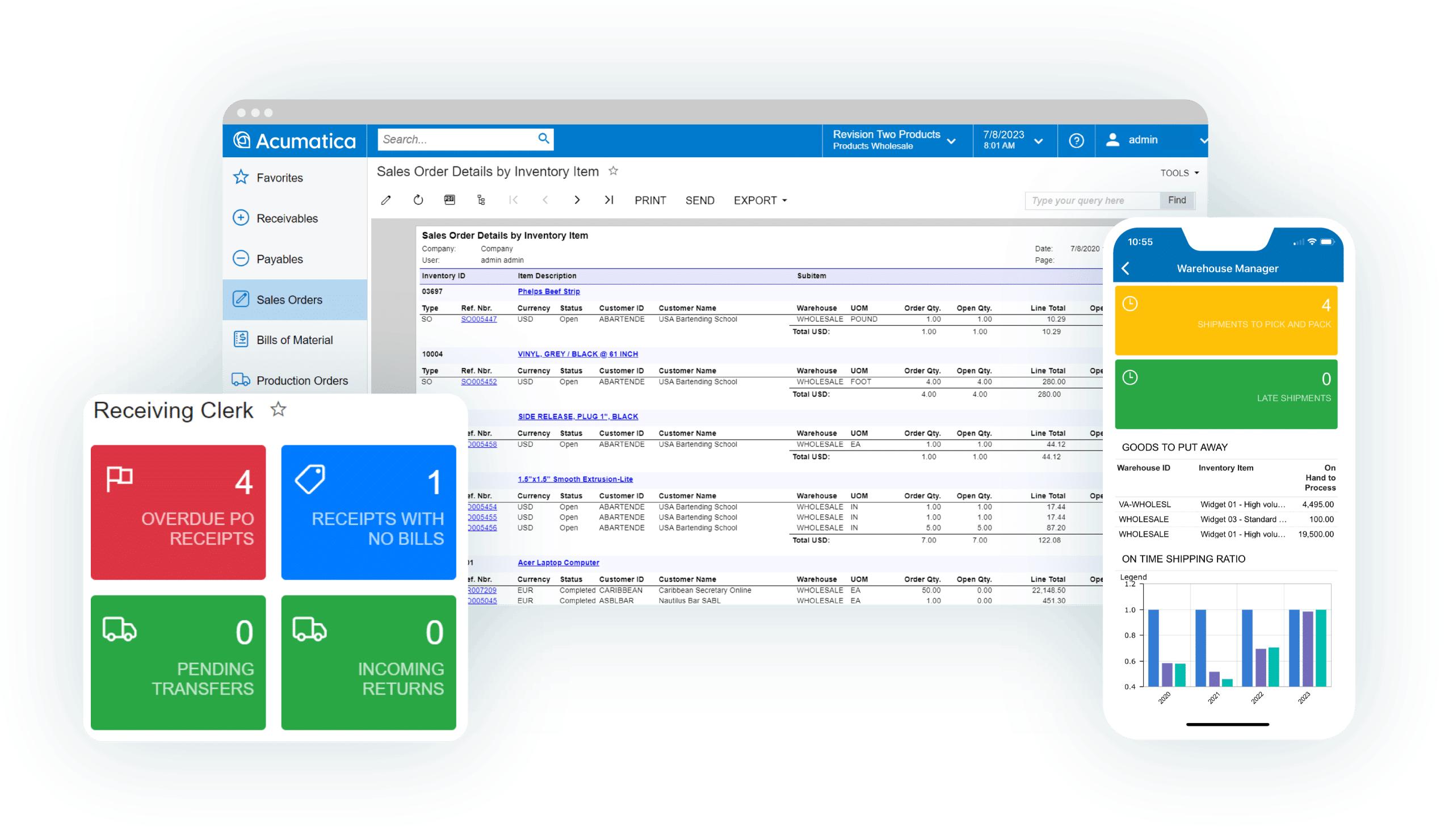
Acumatica is a cloud-based ERP designed for businesses that need flexible, mobile-friendly solutions. It delivers real-time visibility and scalability for growing businesses.
Industries Served:,
Retail, Distribution, Manufacturing, Construction, and Service industries.
Integration Methods:
APIs for seamless integration with eCommerce platforms, CRMs, and financial tools like QuickBooks.
Pricing Models:
Subscription-based pricing based on usage, with no extra cost per user.
Top 5 Features:
- No per-user fees.
- Anywhere, anytime access on mobile.
- Easy integration with other tools.
- Real-time dashboards.
- Custom modules available.
Pros:
- Great value for small businesses.
- Good for working on the go.
- Easy to connect with other apps.
Cons:
- Limited usability for larger companies.
- Fewer partners for support.
- Expertise needed for custom setups.
USP:
Affordable and easy for teams on the move.
Ideal User:
Small companies with multiple remote workers.
Brightpearl
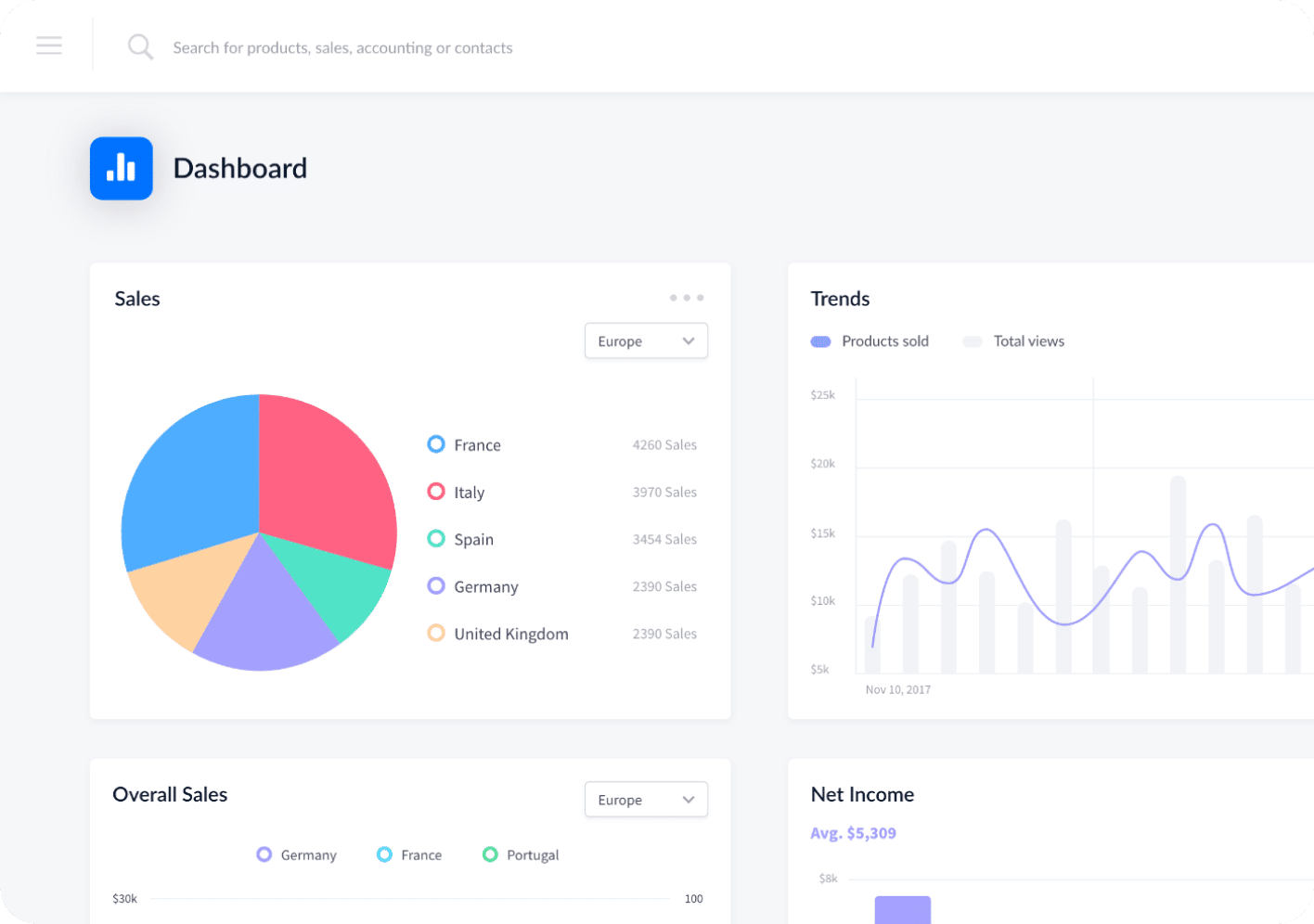
Brightpearl is one of the most common ERP systems preferred by retail businesses which offers features like inventory management, sales tracking, and financial automation.
Industries Served:
Retail and eCommerce.
Integration Methods:
Built-in connectors for major eCommerce platforms (Shopify, Magento, BigCommerce) and accounting tools like Xero.
Pricing Models:
Tiered pricing based on order volume and additional features like advanced analytics.
Top 5 Features:
- Stock and order management made simple.
- Seamless connection with online stores.
- Clear and concise financial reporting.
- Automation for repetitive tasks.
- Effortless handling of multi-channel sales.
Pros:
- Perfect for retail and eCommerce.
- Simplified inventory and sales.
- Time savings through automation.
Cons:
- Not ideal for non-retail companies.
- Limited in terms of advanced tools.
- Third-party apps needed for some features.
USP:
Feature-packed for retail and eCommerce businesses.
Ideal User:
Online stores and retailers with multiple sales channels.
Infor CloudSuite
Infor CloudSuite is a comprehensive ERP tailored for industries like healthcare and manufacturing, offering flexible deployment options and AI-driven insights.
Industries Served:
Healthcare, Manufacturing, Hospitality, Retail, and Automotive.
Integration Methods:
Pre-built integrations with tools like Salesforce and custom connectors for industry-specific applications.
Pricing Models:
Custom pricing depends on the business size and industry.
Top 5 Features:
- Strong focus on specific industries.
- Both cloud and on-site options.
- Easy-to-use dashboards.
- Automated workflows.
- AI for better insights and decision-making.
Pros:
- Designed for specific industries.
- Flexible setup options.
- Simple and clear interface.
Cons:
- Less impactful outside its focus sectors.
- Difficult to use in case of unique non-focus needs.
- Heavy dependence on the company for support.
USP:
Perfect for select industries with specific needs.
Ideal User:
Healthcare and manufacturing companies of all sizes.
Microsoft Dynamics 365
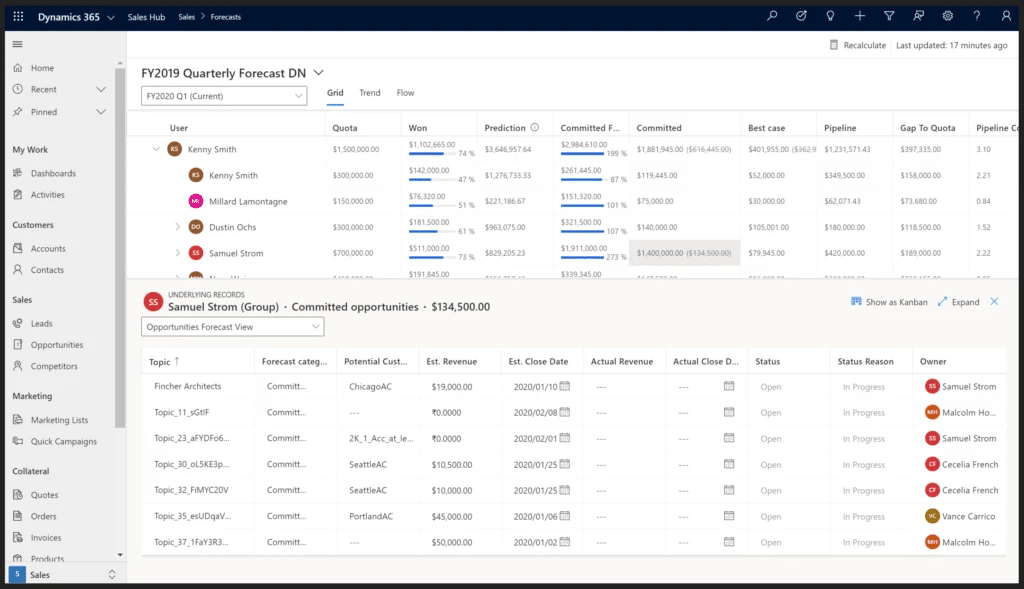
Microsoft Dynamics 365 combines ERP and CRM capabilities, seamlessly integrating with the Microsoft ecosystem for efficient operations.
Industries Served:
Retail, Professional Services, Manufacturing, and Healthcare.
Integration Methods:
Native integration with MS Office 365, Teams, and third-party apps through Microsoft Power Platform.
Pricing Models:
Modular pricing for each app, with subscription tiers based on business size.
Top 5 Features:
- Seamless working with MS Office 365 and Teams.
- AI-driven decision-making support.
- Scalable to fit business growth.
- Easy to customize from plenty of options.
- Efficient management of finance and supply chain.
Pros:
- Perfect fit with other Microsoft tools.
- Faster, smarter work with AI.
- Easily scalable to meet your business needs.
Cons:
- Time-inefficient setup.
- Variable quality of partner support.
- Slow updates due to too many options.
USP:
Great for companies already using Microsoft tools, with strong AI help.
Ideal User:
Medium-to-large businesses that already rely on Microsoft products.
Odoo
Odoo is an open-source ERP with a modular design, offering flexibility and affordability for small businesses.
Industries Served:
Retail, Services, Manufacturing, and Startups.
Integration Methods:
APIs for integration with eCommerce tools, CRMs, and third-party apps like PayPal.
Pricing Models:
Free for the base platform, with additional tools priced per user.
Top 5 Features:
- Open-source and easily customizable.
- Smooth integration with sales channels.
- User-friendly, intuitive interface.
- Low cost for small businesses..
- Option to add more tools with business growth.
Pros:
- Easy to change and grow.
- Great value for money.
- Active community for help.
Cons:
- Challenging initial setup.
- Not ideal for very large businesses.
- Hard to scale in some cases.
USP:
Low-cost ERP with flexible options.
Ideal User:
Small companies that need an affordable ERP.
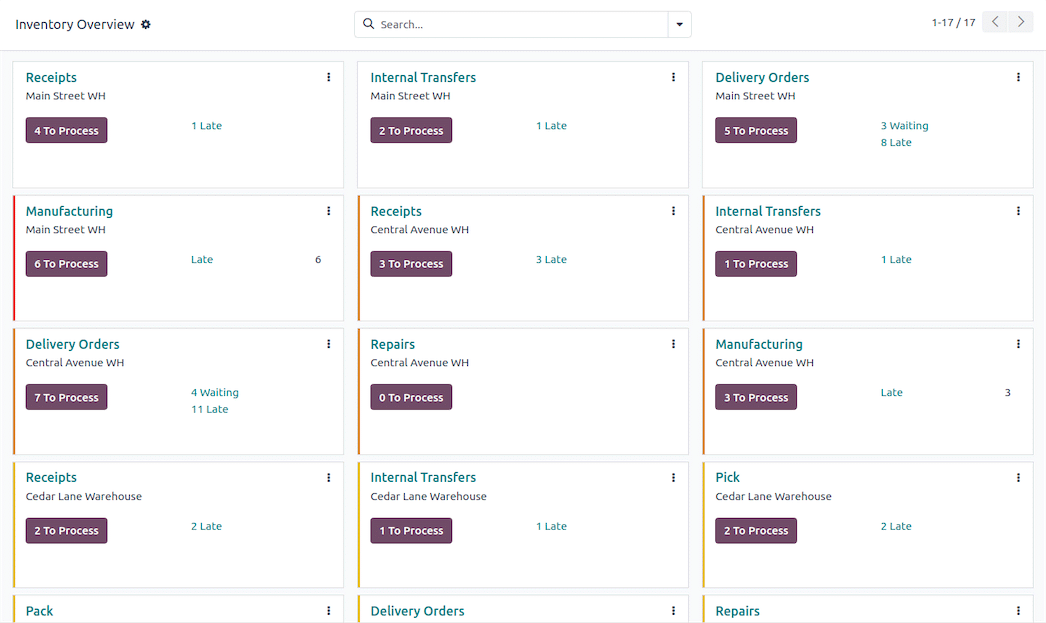
Oracle NetSuite
Oracle NetSuite is a fully cloud-based ERP offering robust tools for small and medium-sized businesses with integrated eCommerce capabilities.
Industries Served:
Retail, Wholesale Distribution, Software, and Manufacturing.
Integration Methods:
Pre-built integrations with eCommerce platforms, CRMs, and financial systems.
Pricing Models:
Annual subscription fee based on modules, users, and business size.
Top 5 Features:
- Completely cloud-based working.
- Especially strong tools for finance.
- Easily scalable to grow with your business.
- Integrated eCommerce capabilities.
- Real-time insights and reports.
Pros:
- Easy to set up and use.
- Built for small businesses.
- Seamless integration with other apps.
Cons:
- Not ideal for bigger companies.
- Costs increase with extra tools.
- Harder to customize.
USP:
Fast and easy for small businesses.
Ideal User:
Small-to-medium businesses just starting out with ERP.
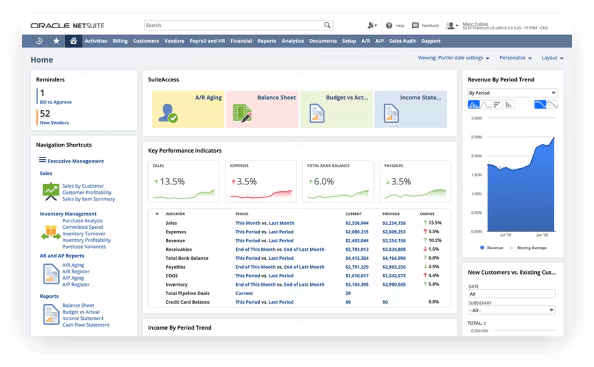
SAP S/4HANA
SAP S/4HANA is a powerful ERP designed for large enterprises, providing real-time data insights and support for global operations.
Industries Served:
Automotive, Retail, Oil & Gas, Utilities, and Manufacturing.
Integration Methods:
API and middleware tools for connecting with third-party systems, including proprietary SAP tools.
Pricing Models:
Custom pricing based on business needs and deployment choice (cloud or on-premises).
Top 5 Features:
- Real-time insights.
- Strong across business areas, including finance and supply chain management.
- Suitable for operations across different countries.
- Made for large businesses with global operations.
- Advanced tools for reporting.
Pros:
- Several tools available for businesses.
- Real-time data for faster decisions.
- Suitable for global operations.
Cons:
- Relatively more expensive.
- Harder to learn and use.
- Extra work needed for unique needs.
USP:
Real-time tools with global reach.
Ideal User:
Large companies working in multiple countries.
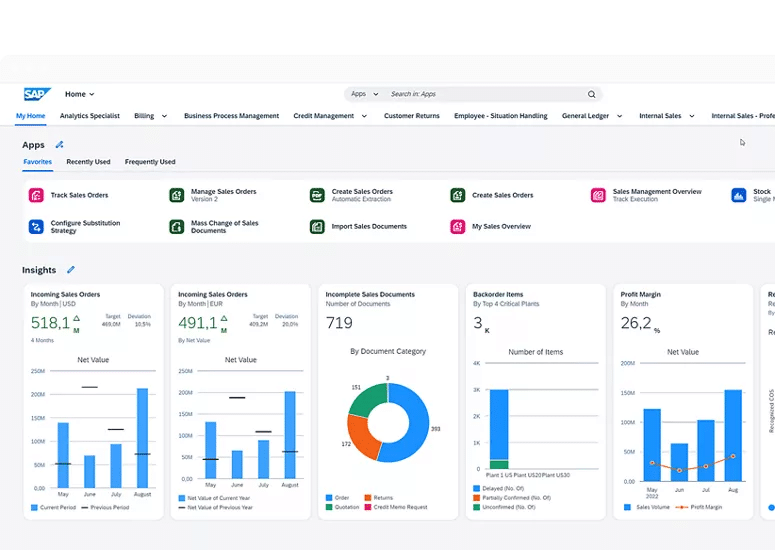
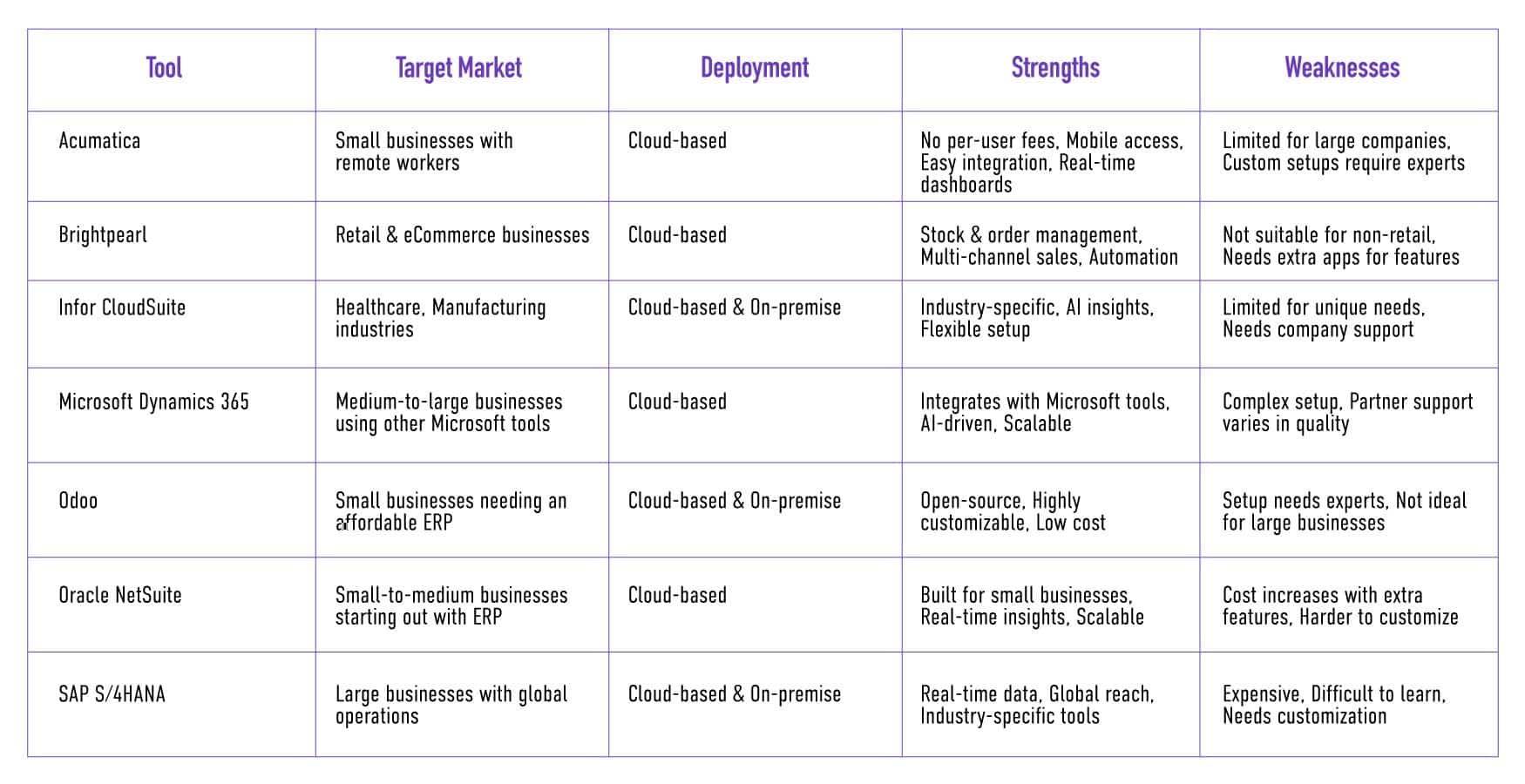
Here’s a quick summary of the key features, pros and cons you should know about the top ERP systems for eCommerce:
Choosing the best ERP for your ecommerce business
1. Software Features
The first step is to ensure it contains the modules and features your business requires. Don’t waste budget on features that you’re not likely to use! Align the ERP with your business; don’t change to suit the new tool.
2. Integrations
An ERP system should be integrated with your other software. Poor integration will prevent efficient operations. Make sure your chosen ecommerce ERP system integrates seamlessly with existing tools and software.
3. Vendor Reputation
Assess the reputation and expertise of the ERP vendor. Check if the provider holds a good track record in your industry and positive client reviews claiming it as the best ERP for ecommerce. Experienced partners are more likely to provide technical support and have a vast community of partners to provide ERP integration services.
4. Costs
Look at the total cost of ownership, including implementation and running costs. Compare the value of different solutions and see which best suits you. Remember, low cost doesn’t necessarily mean best value.
5. Implementation Process
Review how easy it is to implement and how much training is required. Look at what support the vendor provides to ensure smooth implementation and minimal interruption.
6. Future
Finally, how well will the ERP system grow with your business? Ensure it can handle future growth, support software upgrades, and provide ongoing assistance to ensure long-term success. You can consult companies providing ERP integration services as their experience in customizing and maintaining such systems for various eCommerce brands could help.
The benefits of using an eCommerce ERP system
Streamlined operations: ERPs do away with data silos to deliver higher speeds of workflow, fewer human mistakes and easier administration.
Better oversight: ERPs bring together all organization data streams to share real-time information, helping you identify trends and make data-driven decisions.
Scalability:Ecommerce ERP systems can grow to handle more transactions, products, and sales channels as your business expands.
Better customer experience: ERPs help improve customer service by managing orders and personalizing communication.
Success Stories
Walmart with SAP ERP
Problem:
Walmart’s vast operations raised certain issues in day-to-day functioning. They wanted to keep prices low, but this was complicated by the scale of their business, complex supply chain and the constantly changing nature of items on the shelves. Customers needed fast assistance, and Walmart needed a strong plan.
Solution:
Walmart created and implemented a custom SAP eCommerce ERP system to fix these problems. It linked the different sections of the business, improved supply chain management, and provided up-to-date information for quicker and smarter choices. The system fit Walmart’s big operations, and its plans for growth.
Specific Implementation:
Planning and Integration: Walmart linked the new system to old tools in place. As part of the planning stage, they transferred data to ensure the new ERP worked well with existing systems.
Staff Training: Workers were trained on how to use the new system. Walmart helped them adjust to these changes, simplifying operations and work at all levels.
Solving Challenges: By quickly addressing and resolving technical issues and worker concerns, the project kept moving forward.
Real-Time Insights: The ERP system helped Walmart track inventory in real time. This sped up deliveries and made customers happier.
Outcome:
The custom SAP ERP system brought many positive changes:
Better Use of Time: Quicker and more organized ways of working.
Cost Reduction: Lower expenses through automation and data-driven planning.
Stronger Bonds: Happier customers and better connections with partners.
With this ERP system, Walmart cemented their place as a leading player in retail.
In today’s fast-moving eCommerce world, you need integrated systems. An ERP system can serve as the central hub of information that delivers crucial, real-time information like stock levels, price, orders, custom and tiered pricing to the storefronts and operational teams improving operational efficiency and customer experience.
Ziffity, as an agency with over 11 years of expertise in integrating top ERP systems for eCommerce, can help you seamlessly integrate any ERP into your store.
Apart from ERP integration services, we also provide customization, middleware development, support, and maintenance.
Ready to simplify your business? Get started with Ziffity.