“RAG is dead.” You might have come across this claim as long-context LLMs is becoming more popular and capable.
The idea is simple – Why build a separate retrieval system when you can give an LLM all the information it needs in one go? No chunking strategies, no embeddings, no vector databases, no re-ranking mechanisms. Just provide the context and let the model (LLM) do its job.
It sounds like a simpler approach, right? And, despite setting up the tech stack for RAG to work, there are a few chances for the system to miss finding the most relevant information.
With long-context models offering another way to handle large volumes of information, it’s fair to ask whether RAG is still necessary. Are we approaching a point where simpler approaches can replace retrieval altogether? Or does RAG still have a role to play in your business applications? To answer that, let’s look at how RAG works, where it falls short, what makes it still undeniable, and when businesses should use it.
What is RAG?
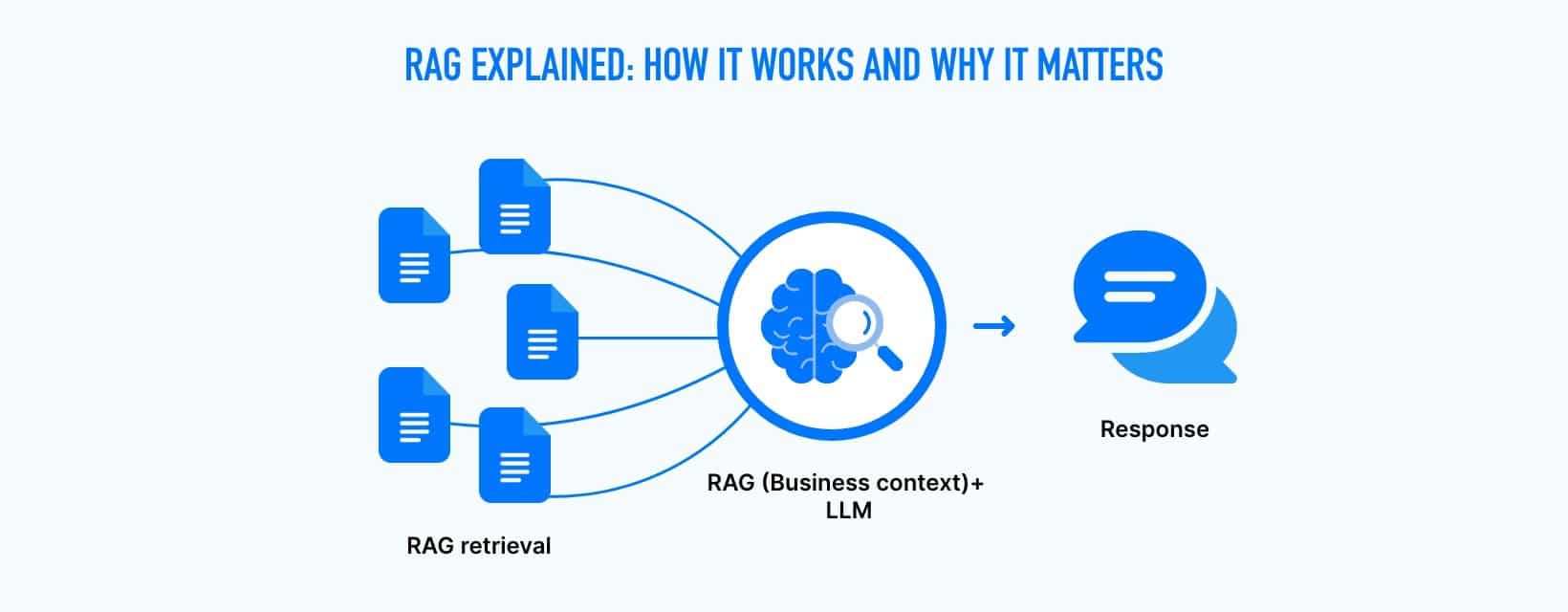
RAG is an approach that enhances Large Language Models (LLMs) by giving them access to relevant external information when generating responses. RAG analyzes relevant data (outside of LLMs’ training data) and generates accurate, data-backed responses.
Large language models (LLMs) can understand questions, reason over information, and generate natural responses. But there is a fundamental limitation. An LLM does not automatically know what is happening inside your business. It may know a lot about your industry, but it does not have access to your latest product catalog, internal policies, customer records, technical documentation, or other proprietary information.
Retrieval-Augmented Generation (RAG) addresses this gap by connecting an LLM to relevant information outside of its underlying training knowledge.
When a user asks a question, a RAG system retrieves relevant information from connected data sources and provides that information to the LLM as context. The LLM then uses that context to generate the response.
In simple terms, RAG brings together three steps:
Retrieval – Find relevant information from your connected data sources.
Augmentation – Add that information to the user’s question as context.
Generation – Let the LLM use the question and retrieved context to generate a response.
For example, consider your employee asking your AI assistant, “What is our current travel reimbursement policy?” A general LLM understands what travel reimbursement policies typically cover, but it cannot know your company’s current policy unless that information has been made available to it. With RAG, the system can retrieve the relevant policy document, provide the LLM with the appropriate information, and generate an answer based on that context.
How does RAG actually work?
RAG, as a concept, sounds simple. Behind the scenes, RAG gets tricky to understand. The working model of an RAG involves two main stages – Data ingestion and Retrieval & Response generation. Let’s start with the Data ingestion.

Data Ingestion
1. Normalizing External Data
The RAG pipeline begins with data ingestion. Raw documents are loaded into an ETL (Extract, Transform, Load) pipeline. The ETL pipeline gathers raw data from disparate sources (PDFs, databases, APIs, and common sources). The transformation stage is where the pipeline cleans text data, standardizes whitespaces and starts ‘chunking’.
2. Chunking, embedding and indexing
Chunking is the part where large documents are split into smaller pieces. Then comes embedding where each chunk is turned into a vector (numbers) using an embedding model so that the RAG can perform semantic searches. The vector form enables RAG to quickly identify information relevant to the user’s query.
3. Embedding
Embedding is one of the most crucial concepts in RAG. This is the part that enables a RAG system to perform semantic search. The relevance and accuracy depend on embeddings and indexing, which we will discuss in the upcoming section of the blog.
So, what role does ‘Embedding’ play in RAG? Before RAG can search your data by meaning, it needs a way to represent that meaning. This is where ‘Embedding’ comes in.
An embedding model converts text (chunks) into a numerical representation called a ‘Vector’. Texts with similar meanings are represented by vectors closer together (in numeric value), even when they use completely different words.
For example, “Is this product available in bulk?” and “Can I order this item in large quantities?” use different words but convey the same meaning. These user prompts, when converted into vectors through embeddings, they turn into almost identical vectors. Their embeddings can therefore be positioned close to each other in the vector space.
RAG uses this semantic relation to find the most relevant information. Instead of looking only for exact keyword matches from source data, it can identify content that is meaningfully related to the user’s question.
4. Loading and Indexing
The loading stage stores the embedded vectors along with the meta data (which holds crucial information like its source, document title, date, time stamp etc.) This metadata information plays a crucial role in retrieving information based on a specific date range, role etc.
Also remember that every RAG system needs regular updates (indexing) in order to fetch the latest information and maintain relevance. Whenever you update your data source, ensure that you have automated pipelines in place to detect new information and trigger a re-embedding (indexing).
This helps you keep your RAG knowledge base up to date. With this, the data for RAG to retrieve is ready. It’s time to quickly summarize what we’ve discussed so far.
Retrieval and Response generation

5. Retrieval Pipeline (Online Phase)
The retrieval pipeline comes into play when a user asks a question. This is the phase where the RAG leverages the vector knowledge base and the handoff between RAG and your LLM happens.
Query Embedding
The retrieval starts like a reverse embedding process. Once a search query is entered, it is converted into a vector through ‘Query embedding’. The RAG fetches the query vector and starts looking for similar chunks in every available vector database.
Retrieval
Retrieval can happen in three ways – Sparse retrieval, Dense retrieval, and Hybrid. ‘Sparse retrieval’ looks for vectors that exactly match the user’s prompt. ‘Dense retrieval’ looks for vectors that have contextually similar content. This is where the semantic search capability of RAG comes into play.
The ‘Hybrid’ approach combines both retrieval methods, and the source with the highest ranking in both methods will be chosen. At this stage, your RAG system is ready with the most relevant information to pass on to the LLM.
Response Generation
The retrieval phase gathers relevant information from the vector database and hands it over to the LLM. The LLM now has the necessary information based on which it generates a response that’s backed by facts. For example, if a user asks, “What are your warranty terms?”, your RAG system will extract data from your company’s warranty documents.
Your LLM now acts based on the facts RAG has helped it retrieve instead of relying heavily on its training. The LLM generates responses with citations from internal or external sources that the user can verify.
Bring the right expertise together to implement RAG.
RAG implementation requires more than AI development skills. You’ll need people who understand your business data, AI or LLM integration, and application development. Depending on your use case, you may also need security and domain experts. Make sure these skills are available within your team or through an implementation partner before you begin.
Why does RAG matter for Enterprise AI?
“Information and access to it” – This is what it takes to make an application effective. An AI application is only as useful as the information it can access when it needs to answer a question. Access to information is essential for accuracy, relevance, and preventing AI hallucination.
For a business like yours, that information often rests across documents, databases, knowledge bases, FAQs, business applications, and other systems (ERP, CRM) which keep changing over time.
An LLM can understand a question and generate a well-written response. But it does not have access to your organization’s latest information. This creates a gap between what a general LLM can do and what you expect your enterprise AI application to do.
RAG bridges that gap by allowing an AI application to retrieve relevant information from your business data at the time a question is asked. This becomes valuable in situations where the information needed is confidential (inter-organizational data), domain-specific, or frequently changing.
RAG vs LLM – What’s the difference?

RAG vs LLM – Key differences
5 reasons why you shouldn’t completely rely only on LLMs
While Large Language Models (LLMs) can generate human-like responses, they have limitations when used on their own in enterprise environments.
1. AI hallucinations
LLMs can generate convincing answers that are incorrect or unsupported, especially when they lack relevant context. Industry studies state that LLM hallucinations can go up to 58% for complex tasks. In healthcare and financial services, inaccuracies can lead to compliance violations and heavy losses.
2. Outdated knowledge
LLMs depend on training data only. They don’t know the latest updates to your portfolio, policies, or business processes. You’ll have to retrain your LLM to keep its knowledge up to date.
3. Access limitations
LLMs do not have access to your organization’s confidential documents like price details, customer data, policies, and guidelines. LLMs will struggle to answer questions based on specific business data.
4. Traceability
Your LLM does not provide verifiable source links for every response. As a business owner, this makes it difficult for you to check sources and validate accuracy when needed.
5. Scalability challenges
As your business grows, the volume and complexity of data that an LLM needs to process can increase significantly. Keeping responses accurate requires a reliable way to retrieve information from growing datasets without overwhelming the model or increasing operational costs. This is where approaches like RAG become valuable as they allow LLMs to access information on demand without having to incorporate the entire dataset into the model itself.
Know when an LLM is enough and when you need RAG.
Not every AI application needs RAG. An LLM alone may work well for general questions and tasks. But if your AI needs accurate, up-to-date information from your business data, RAG can help. Choose the approach based on what your business needs the AI to do.
When should your business use RAG?
Not every AI application needs access to an entire enterprise knowledge base. The right approach depends on the kind of information your application works with. Let’s look at the scenarios that make RAG essential for your enterprise AI applications.
1. When your business information continuously grows or changes frequently
Your business’ contracts, product specifications, governance policies, usage policies, and legal agreements can change regularly. Without RAG, keeping an LLM’s knowledge aligned with these changes may require additional processing or model updates. RAG allows your AI applications to retrieve the latest relevant information from connected data sources at query time, reducing the need to retrain the model whenever information changes.
2. When relevant information is buried in large volumes of data
Even if your LLM has access to extensive information, finding the right details can be challenging. Why? Your LLM’s context window will have too much unrelated content. This can dilute the relevance of the information presented to your LLM, which, in turn, increases the risk of inaccurate responses. The attention mechanism of your LLM gets diluted. RAG helps narrow the context to information relevant to the user’s query, giving your LLM a clearer base for generating its answer.
3. When your business data is too large to fit into the context window
LLMs have evolved to have large context windows that can process millions of tokens. In an enterprise ecosystem, that accounts to only to a fraction of entire data spread across policy documents and internal systems. If you want a data set that stores every bit of enterprise information, you must have a retrieval layer to narrow information to fit it into your LLM’s context window. RAG overcomes this challenge by retrieving a smaller set of relevant information that fits within the model’s context window.
Knowing when to use RAG is just one step, but that is not all. You also need to ask another key question. Can you trust its answers? Just because RAG retrieves information from your business data doesn’t mean every answer will be accurate or reliable.
Does RAG guarantee accurate and trustworthy responses?
RAG helps an LLM generate responses based on relevant business information rather than relying only on what it learned during training. But that doesn’t automatically make every response accurate or trustworthy.
Let’s understand this with an example. Consider a RAG system recommending a product without considering a compatibility requirement. Or take another example where your AI application reveals internal information to someone who shouldn’t have access?
In both these cases, the system has done its job. It has retrieved information and generated a response as expected, yet the outcome could still be wrong or risky for your business.
This happens because RAG does one thing right – improves LLM’s access to information. When it comes to reliability or accuracy, it’s completely a different game. The reliability and accuracy depend on factors like the data it relies on, how well it follows access permissions and finally, how consistently are its responses tested and monitored.
Let’s look at four factors that can influence how reliably your RAG application performs.
1. Retrieval Quality: Is the system finding the right information?
Even when your business has the right information, a RAG-based application may not always find the information needed to answer a question. It might miss an important detail, retrieve an outdated passage, or pull information that seems relevant but doesn’t address the actual question.
For instance, imagine a customer asking about product compatibility with their existing equipment. The system might retrieve a general product description without considering the compatibility details available in another document.
The response might be convincing. When a customer decides to act based on it, it could lead to a wrong purchase. This in turn, affects your brand credibility and increase operational responsibilities like handling return requests, restocking, repacking etc. The key problem is the problem becomes harder to identify when the answer sounds reasonable. To reduce this risk, you should test how well the system retrieves information for different types of questions. Mainly for queries that demands RAG to compare and collect information from multiple documents.
You should build a mechanism to consistently review what kind of information the system misses and when it return unrelated content.
2. Source Data Quality: Is the information reliable?
Finding the right document doesn’t help if the document itself is wrong or outdated. Business information changes constantly. Product prices are revised, policies are changed, inventory fluctuates, and also customer records need frequent updates. If outdated or conflicting information remains in the data sources connected to a RAG application, the system may retrieve it and use it to generate an answer that is no longer valid.
The business risk isn’t limited to inaccurate answers. It can also lead to operational disruptions, poor customer experiences, and decisions based on information that is no longer true.
If you have RAG in your enterprise AI application, you should establish stakeholders for data ownership and define how information is reviewed, updated, and archived. Make sure that the system prioritizes authentic records and addresses conflicting records while retrieving information. Also, ensure that your RAG system is equipped enough to verify details like dates, and versions of the data source if necessary.
3. Access Permissions: Is the system sharing only what it should?
Making business information available to an AI application introduces another important question: who is allowed to see that information? Employees in different departments, business owners, and financial experts all require access to certain information, but it is important to restrict those that are irrelevant to them.
Without these boundaries, a RAG system could expose sensitive data to employees, customers, or even competitors using an AI bot. Such incidents can create compliance risks in terms of data security.
You should ensure that the levels of access controls and permissions are applied to the RAG application as well. Like any inter-organizational system with access permissions, RAG systems should also limit what information is revealed based on the user’s identity or role. Also, the system should be made aware of permission changes. Do all of this before the response generation stage.
4. Evaluation and Monitoring: Does the system remain reliable over time?
A RAG application may work fine during the initial phase of testing. The real test begins when real users start asking questions. It might have to face unique queries phrased in a variety of ways or face unfamiliar scenarios which weren’t covered during development.
Your customer support assistant could be answering questions accurately but could provide incorrect warranty information even after your company’s policy changes. If the assistant is not checked after go live, your employees and customers will continue to receive incorrect information which you might not realize until complaints start pouring in.
Without planned audits, these inefficiencies and inaccuracies can go unnoticed in an enterprise ecosystem. So make sure you don’t stop testing RAG systems after go live. Test whether the responses reflect the data sources and understands when information is insufficient. Your RAG should be smart enough to perform human handoff when required.
Treat RAG reliability as an ongoing business responsibility.
Don’t assume that connecting an LLM to your business data makes its trustworthy. Assign stakeholders to take care of data quality. Continuously assess what inaccurate answers cause to your business. Make regular testing and monitoring a part of your plan, even after deployment.
Final words
As long-context LLMs evolve, your organization’s AI apps can easily work with large volumes of information. But that doesn’t mean RAG has lost its place. Both RAG and long-context LLM approaches have their strengths. The right choice depends on what your business needs.
If your AI application works well with a fixed set of information, a long-context model may be enough. But if you need to retrieve specific details from large, frequently changing business datasets, RAG can still be a practical choice. The key is to understand your use case before deciding which approach to take.
As you explore AI for your business, don’t choose a solution just because it’s new or popular. Focus on what you need it to do, the information it must work with, and the results you expect. That will help you make a decision that works for your business today and as it grows.
Looking to make AI more useful for your business? Talk to our AI experts to explore the right approach for your needs.